
Aadhaar Data Vault API Securely Store and Tokenize Aadhaar Data
Protect sensitive Aadhaar information with a secure data-vault API designed to encrypt Aadhaar numbers, generate reference keys, and minimize the use of actual Aadhaar numbers across your application ecosystem.
UIDAI defines an Aadhaar Data Vault (ADV) as a separate secure system for storing Aadhaar numbers and connected Aadhaar data received by eligible Requesting Entities. UIDAI’s guidance emphasizes encryption, restricted access, logical segregation, and reference keys that can replace Aadhaar numbers within an organization’s broader ecosystem.
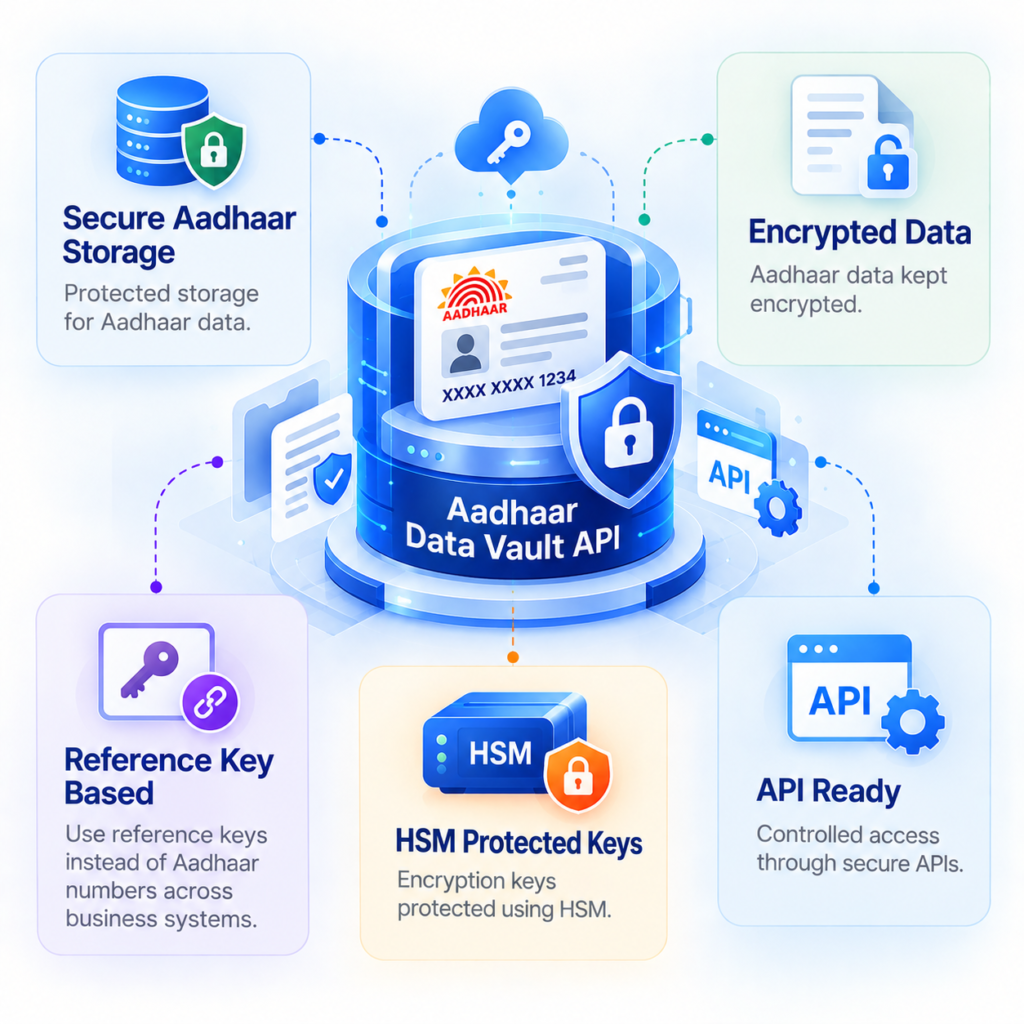
End-to-End Flow
Submit Aadhaar Data
Validate Request
Encrypt Aadhaar Information
Generate Reference Key
Store in Secure Vault
Protect Encryption Keys
Retrieve Using Reference Key
Complete Business Workflow
Key Capabilities
Secure Aadhaar Storage
Store full Aadhaar numbers and applicable connected Aadhaar data within a dedicated vault where required by the applicable framework. UIDAI states that full Aadhaar numbers and connected Aadhaar data received through e-KYC must be stored only within the ADV for entities subject to that requirement.
Aadhaar Encryption
Encrypt Aadhaar information before storing it in the vault.
Reference Key Generation
Generate unique reference keys that can be used across the organization’s ecosystem instead of the actual Aadhaar number. UIDAI specifies that reference keys are intended to reduce the footprint of Aadhaar numbers.
HSM-Based Key Protection
Support secure management of encryption keys using a Hardware Security Module. UIDAI’s current FAQ states that encryption requirements should follow the latest applicable UIDAI authentication/e-KYC specifications.
Tokenized Access
Use reference-based access to reduce unnecessary exposure of Aadhaar numbers across applications.
Access Control
Implement restricted access to sensitive Aadhaar information based on authorized business requirements.
Audit & Traceability
Maintain appropriate logs and metadata for monitoring and audit requirements.
Secure API Integration
Connect vault operations with existing KYC, onboarding, lending, and financial systems.
Use Cases

Banking & Financial Services
Securely manage Aadhaar information used within eligible banking and financial workflows.

Digital Lending & KYC
Protect Aadhaar information collected during customer onboarding and loan processes.

Customer Identity Management
Reduce exposure of Aadhaar numbers across internal applications by using reference keys.
Developer Experience
Simple API Integration
Integrate Aadhaar vault operations into existing applications through secure API endpoints.
Reference-Based Architecture
Use reference keys within your application ecosystem instead of passing the actual Aadhaar number between systems wherever applicable.
Secure Encryption
Protect stored Aadhaar information using encryption and appropriate key-management controls.
HSM Integration
Support secure cryptographic key management through HSM-based infrastructure.
Controlled Access
Build role-based and authorized access into your Aadhaar data-management workflow.
Audit Ready
Maintain appropriate transaction and access records for security monitoring and applicable compliance requirements.
Suggested Input
Illustrative structure exact fields should follow your production implementation.
{
  "aadhaar_number": "XXXXXXXX1234",
  "reference_id": "CUST100001",
  "consent": true
}
Suggested Output
Illustrative structure exact fields should follow your production response.
{
  "client_id": "FINXXXXXX",
  "reference_id": "CUST100001",
  "vault_reference_key": "AVK_8F72K91X",
  "storage_status": "STORED",
  "encryption_status": "ENCRYPTED",
  "verification_status": "SUCCESS"
}
Implementation note: The exact vault architecture, request/response fields, encryption configuration, HSM implementation, retention controls, and access policies should follow the applicable UIDAI requirements and your authorized production implementation. UIDAI’s current documentation specifically requires entities storing full Aadhaar numbers and connected Aadhaar data to implement an Aadhaar Data Vault.
Frequently Asked Questions
What is an Aadhaar Data Vault?
An Aadhaar Data Vault is a dedicated secure system for storing Aadhaar numbers and connected Aadhaar information received by eligible Requesting Entities. Its objective is to minimize the footprint of Aadhaar numbers by securely storing the information and using reference mechanisms within the wider ecosystem.
Why use an Aadhaar Data Vault?
An Aadhaar Data Vault helps organizations centralize and secure eligible Aadhaar information while reducing the need to expose the actual Aadhaar number throughout their application ecosystem.
What is a reference key?
An Aadhaar Data Vault helps organizations centralize and secure eligible Aadhaar information while reducing the need to expose the actual Aadhaar number throughout their application ecosystem.
Is Aadhaar data encrypted?
Yes. Aadhaar information stored in the vault must be protected through appropriate encryption and security controls. UIDAI's current FAQ states that encryption requirements should comply with the latest applicable UIDAI authentication and e-KYC specifications.
What is the role of an HSM?
A Hardware Security Module (HSM) provides a controlled environment for protecting cryptographic keys and performing sensitive cryptographic operations. Aadhaar Data Vault implementations can use HSM infrastructure as part of their security architecture.
Who needs to implement an Aadhaar Data Vault?
UIDAI states that Requesting Entities storing full Aadhaar numbers along with connected Aadhaar data in accordance with the Aadhaar Act, regulations, and applicable directions/guidelines are required to implement an Aadhaar Data Vault.
Can applications use PAN or another identifier as a reference key?
UIDAI's current FAQ states that organizations may use unique reference keys, including existing unique values where appropriate, provided the key can be uniquely mapped to the Aadhaar number and meets the applicable ADV requirements. It also cautions organizations to consider the implications of using values such as PAN or bank-account numbers as reference keys.