
eAadhaar Verification API Verify e-Aadhaar Documents with Digital Signature Validation
The eAadhaar Verification API enables businesses to verify an electronic Aadhaar document and process identity information through an API-driven offline verification workflow. e-Aadhaar is a password-protected electronic copy of Aadhaar that is digitally signed by UIDAI.
The API is designed for businesses that need to incorporate e-Aadhaar verification into customer onboarding, KYC, lending, financial services, insurance, telecom and other identity-dependent workflows. Under UIDAI’s offline-verification framework, e-Aadhaar is one of the recognized forms of offline verification, distinct from online Aadhaar authentication.
End-to-End Flow
Customer Provides e-Aadhaar
e-Aadhaar Is Submitted
Document Is Processed
Digital Signature Is Validated
Identity Information Is Extracted
Verification Result Is Generated
Business Rules Are Applied
Structured Response Is Returned
Key Capabilities
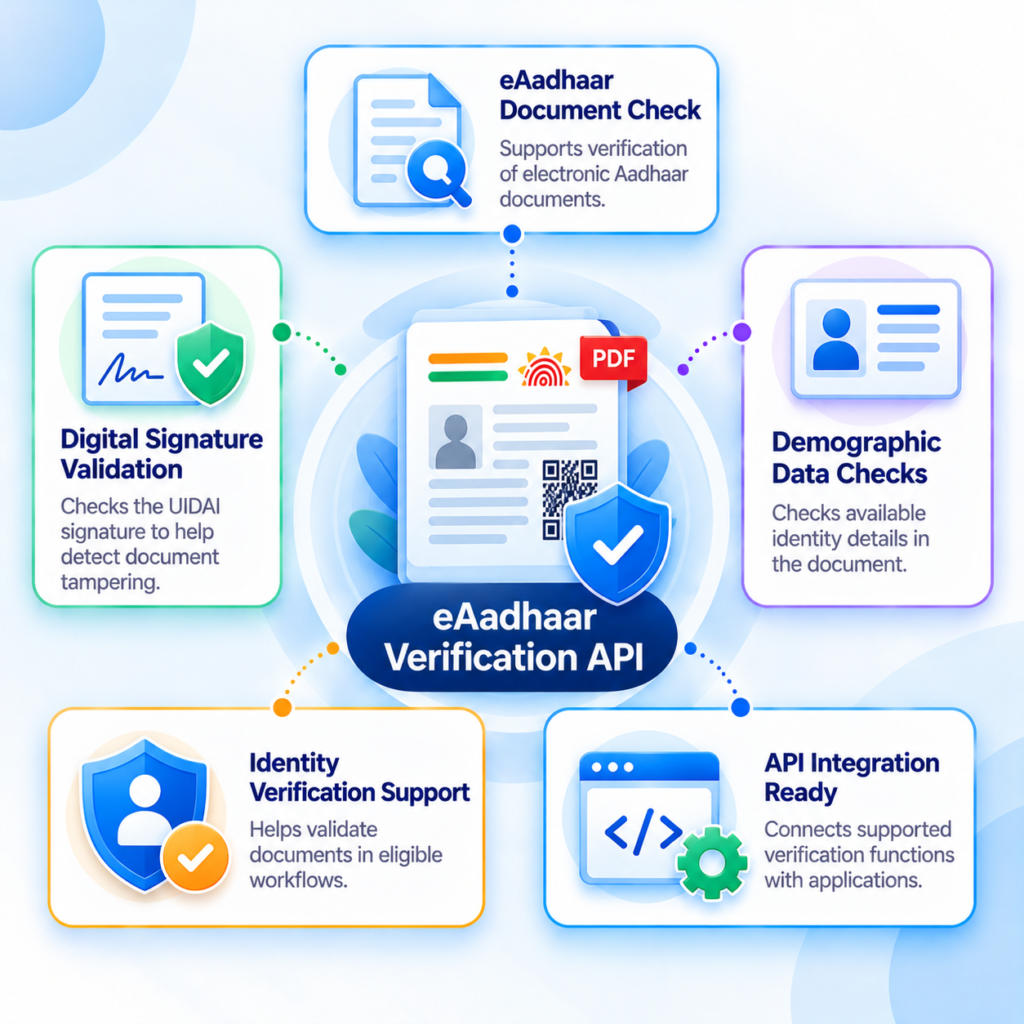
e-Aadhaar Document Verification
Verify an electronic Aadhaar document through a digital-signature-based offline verification workflow.
Digital Signature Validation
Validate the UIDAI digital signature associated with e-Aadhaar to help establish document authenticity. UIDAI identifies digital-signature verification of e-Aadhaar as an approved offline verification method.
Identity Data Extraction
Extract applicable identity information from the verified document for use in downstream applications.
Document Authenticity Check
Help identify whether the submitted e-Aadhaar document passes the applicable authenticity and signature validation process.
Structured Response
Return applicable verification information in a machine-readable structure suitable for enterprise applications.
Paperless KYC Workflow
Integrate electronic identity verification into digital onboarding processes without depending solely on physical Aadhaar documents.
Offline Verification Architecture
Support the offline-verification model in which the entity verifies the UIDAI digital signature rather than requesting an online authentication response from UIDAI.
Enterprise Workflow Integration
Connect e-Aadhaar verification with CRM, LOS, LMS, onboarding, KYC and other identity-dependent applications.
Use Cases

Banking & Financial Services
Integrate e-Aadhaar verification into eligible customer onboarding and account-opening workflows.

Lending & NBFC
Use document verification as part of borrower onboarding and loan-application processing.

Fintech KYC
Add digital Aadhaar document verification to fintech registration and KYC workflows.
Developer Experience
Secure REST APIs with eAadhaar document verification and structured JSON responses for seamless identity validation and digital onboarding.
API-Based Integration
Connect e-Aadhaar verification with existing applications through an API-driven architecture.
Document Processing
Submit the supported e-Aadhaar representation to the verification workflow for document and signature processing.
Structured JSON
Receive machine-readable verification information that can be consumed by KYC, CRM, onboarding or risk systems.
Verification Status
Use the response status to determine whether the submitted document successfully passed the applicable verification checks.
Workflow Ready
Connect verification results with LOS, LMS, CRM, KYC engines and customer onboarding platforms.
Secure Data Handling
Aadhaar information is sensitive identity data. Implement appropriate consent, access-control, encryption, retention and audit practices according to applicable UIDAI requirements and organizational policies.
Suggested Input
Illustrative structure — exact FinAnalyz production schema may differ:
{
“reference_id”: “FIN-EAADHAAR-XXXXXX”,
“document”: “<BASE64_OR_FILE_REFERENCE>”,
“consent”: true
}
The actual FinAnalyz implementation may use multipart document upload, a file reference, encoded document data or another supported mechanism. The production request schema should be confirmed against the FinAnalyz API documentation.
Suggested Output
Illustrative structure — exact FinAnalyz production schema may differ:
{
“reference_id”: “FIN-EAADHAAR-XXXXXX”,
“verification_status”: “VERIFIED”,
“signature_status”: “VALID”,
“document_status”: “VALID”,
“name”: “<MASKED_NAME>”,
“date_of_birth”: “<YYYY-MM-DD>”,
“gender”: “<GENDER>”,
“address”: “<MASKED_ADDRESS>”,
“aadhaar_last_four”: “XXXX”,
“status”: “SUCCESS”
}
The exact fields returned should be aligned with the FinAnalyz production schema and the information permitted under the applicable Aadhaar offline-verification framework.
Frequently Asked Questions
What is e-Aadhaar?
e-Aadhaar is a password-protected electronic copy of Aadhaar digitally signed by UIDAI. UIDAI states that e-Aadhaar is equally valid as a physical Aadhaar copy for applicable purposes.
What is eAadhaar Verification?
eAadhaar Verification is the process of verifying an electronic Aadhaar document, including validating its UIDAI digital signature as part of the applicable offline-verification framework.
Is e-Aadhaar verification different from Aadhaar online authentication?
Yes. e-Aadhaar verification is an offline verification method. Online Aadhaar authentication is a separate service in which authorized entities request an authentication response from UIDAI. UIDAI regulations explicitly distinguish e-Aadhaar verification from online authentication.
What information can be obtained from e-Aadhaar?
The information available depends on the e-Aadhaar representation and verification method. The broader Aadhaar secure QR mechanism can contain information including name, address, gender, date of birth, photograph and masked contact information.
Does e-Aadhaar contain a digital signature?
Yes. UIDAI defines e-Aadhaar as a digitally signed electronic copy of Aadhaar. The digital signature can be verified as part of offline verification.
Does e-Aadhaar verification require an OTP?
Not necessarily. e-Aadhaar verification is an offline verification mechanism and should not be confused with Aadhaar online authentication, which can use OTP or biometric modes.
Is customer consent required?
Organizations should obtain the required consent and conduct Aadhaar offline verification only for a lawful and applicable purpose. The entity's obligations depend on its role and the applicable Aadhaar regulations.