
Aadhaar OVSE API Simplify Digital Identity Verification with the Aadhaar OVSE API
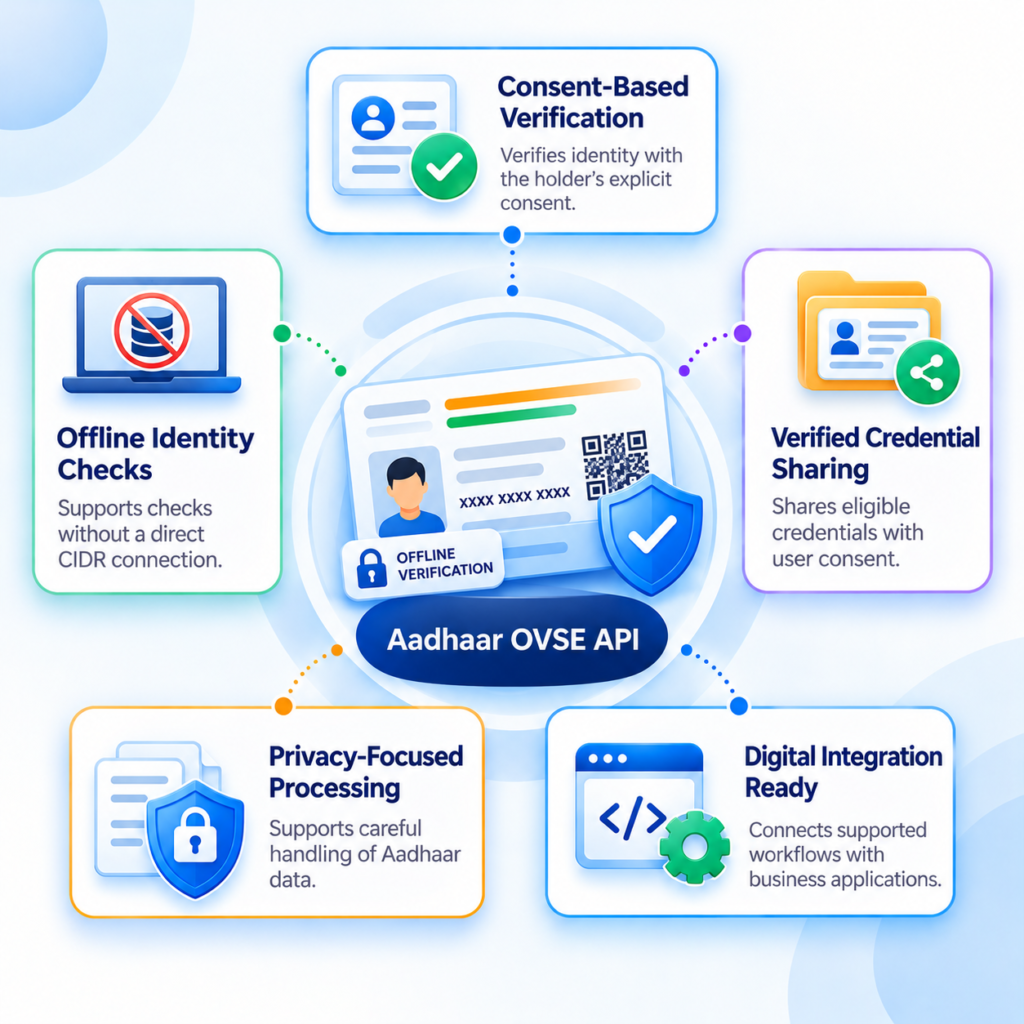
The Aadhaar OVSE API enables eligible businesses to perform consent-based offline Aadhaar identity verification without connecting to UIDAI’s central database (CIDR). It supports paperless verification through methods such as Aadhaar App sharing and QR-based verification, helping streamline customer onboarding and identity checks across financial services, recruitment, hospitality, rentals, and other industries. Exact verification methods and response fields depend on the integration.
End-to-End Flow
Initiate Verification
Present the Verification Option
Explain Data Usage and Obtain Consent
Customer Shares Credentials
Validate the Shared Credentials
Process Verification Information
Return the Verification Result
Complete Onboarding
Key Capabilities
Aadhaar App Integration
Support an integrated verification journey in which customers share Aadhaar-verified credentials through compatible Aadhaar App workflows. Availability depends on the implementation and registration requirements.
QR-Based Verification
Enable supported QR-based Aadhaar verification flows, allowing users to share credential information digitally rather than relying solely on manual document inspection.
Consent Management
Build consent capture into the verification process, including disclosure of requested information, intended use, and viable alternatives as required by the applicable framework.
Digital Credential Validation
Validate applicable digital credentials and signatures to help identify invalid or altered credential files where the selected verification method supports these checks.
Selective Credential Sharing
Support workflows that request only the permitted information needed for a verification purpose, depending on the credential type and available functionality.
Use Cases

Banking and Financial Services
Integrate Aadhaar offline verification into eligible customer onboarding and identity-check workflows, subject to applicable requirements.

Fintech and Digital Lending
Use consent-based identity verification as one component of customer onboarding for digital lending, wallets, and other financial products.

Hospitality and Travel
Verify guest identities during check-in and reservation-related processes through supported digital credential-sharing journeys.
Developer Experience
Enable seamless, consent-based Aadhaar offline identity verification through API integration, supported credential-sharing workflows, and structured verification responses.
REST API Integration
Connect the verification workflow to web or mobile applications through the API interface documented for the FinAnalyz implementation.
Aadhaar App Workflow Support
Integrate compatible user journeys for initiating verification and receiving shared credentials or verification outcomes.
Structured JSON Responses
Map verification status and permitted credential details into internal systems using the response schema supplied with the production API.
Consent-Aware Processing
Design the integration to record the required consent and ensure that data is processed only for the disclosed and permitted purpose.
Enterprise System Integration
Connect verification outcomes with KYC platforms, customer onboarding systems, CRM tools, HR platforms, and risk-management workflows.
Security and Compliance
Protect credentials in transit and at rest, restrict access to sensitive data, and implement applicable retention, deletion, and consent-withdrawal requirements.
Suggested Input
Illustrative structure only — this is not a confirmed FinAnalyz production request schema. An OVSE integration may initiate a session rather than accept an Aadhaar number directly. The actual request depends on the supported workflow.
{
“reference_id”: “FIN-OVSE-001”,
“verification_method”: “aadhaar_app”,
“purpose”: “customer_onboarding”,
“consent”: true,
“callback_url”: “https://example.com/verification/callback”
}
Suggested Output
Illustrative structure only — confirm the actual fields, statuses, and callback behavior against the FinAnalyz API specification.
{
“reference_id”: “FIN-OVSE-001”,
“verification_status”: “VERIFIED”,
“verification_method”: “aadhaar_app”,
“credential_validation”: “SUCCESS”,
“verified_data”: {
“name”: “MASKED CUSTOMER”,
“aadhaar_reference”: “XXXX-XXXX-1234”
},
“status”: “SUCCESS”
}
Implementation note: The example fields are placeholders, not a representation of an official response schema. Only include customer details that are actually returned by the selected workflow and permitted for the stated purpose.
Frequently Asked Questions
What is an Aadhaar OVSE API?
An Aadhaar OVSE API enables an eligible organization to integrate Aadhaar offline verification into its applications. OVSE means Offline Verification Seeking Entity, an entity that undertakes Aadhaar offline verification under the applicable UIDAI framework.
How is OVSE verification different from Aadhaar authentication?
Aadhaar authentication involves submitting an authentication request to UIDAI's Central Identities Data Repository. Offline verification uses credentials shared by the Aadhaar holder and does not require a live authentication request to CIDR.
Does the user need to provide their full Aadhaar number?
Not necessarily. Certain offline verification methods can operate without collecting or storing the full Aadhaar number. The information available depends on the selected credential and workflow. UIDAI's offline XML process, for example, provides a reference containing the last four digits rather than requiring the verifier to store the full number.
Is customer consent mandatory?
Yes. The applicable framework requires the entity to inform the Aadhaar holder about the information being shared, the intended use, and alternatives, and to obtain consent for verification. Consent records must be maintained as required by the regulations.
Does a business need OVSE registration?
An entity seeking to undertake Aadhaar Paperless Offline e-KYC or Aadhaar Verifiable Credential verification through the Aadhaar Application must follow the applicable UIDAI registration process. Registration is subject to UIDAI's eligibility and approval requirements.
Can the API be integrated with existing business systems?
Yes, the API can be designed to connect with existing applications and onboarding workflows. The available integration methods, callbacks, and response fields depend on the FinAnalyz implementation.
Can the API verify Aadhaar credentials without an OTP?
Offline verification is distinct from online Aadhaar authentication and does not require an online CIDR authentication request. However, the customer journey may involve steps required by the particular credential-sharing method. Do not assume every OVSE workflow is OTP-free.