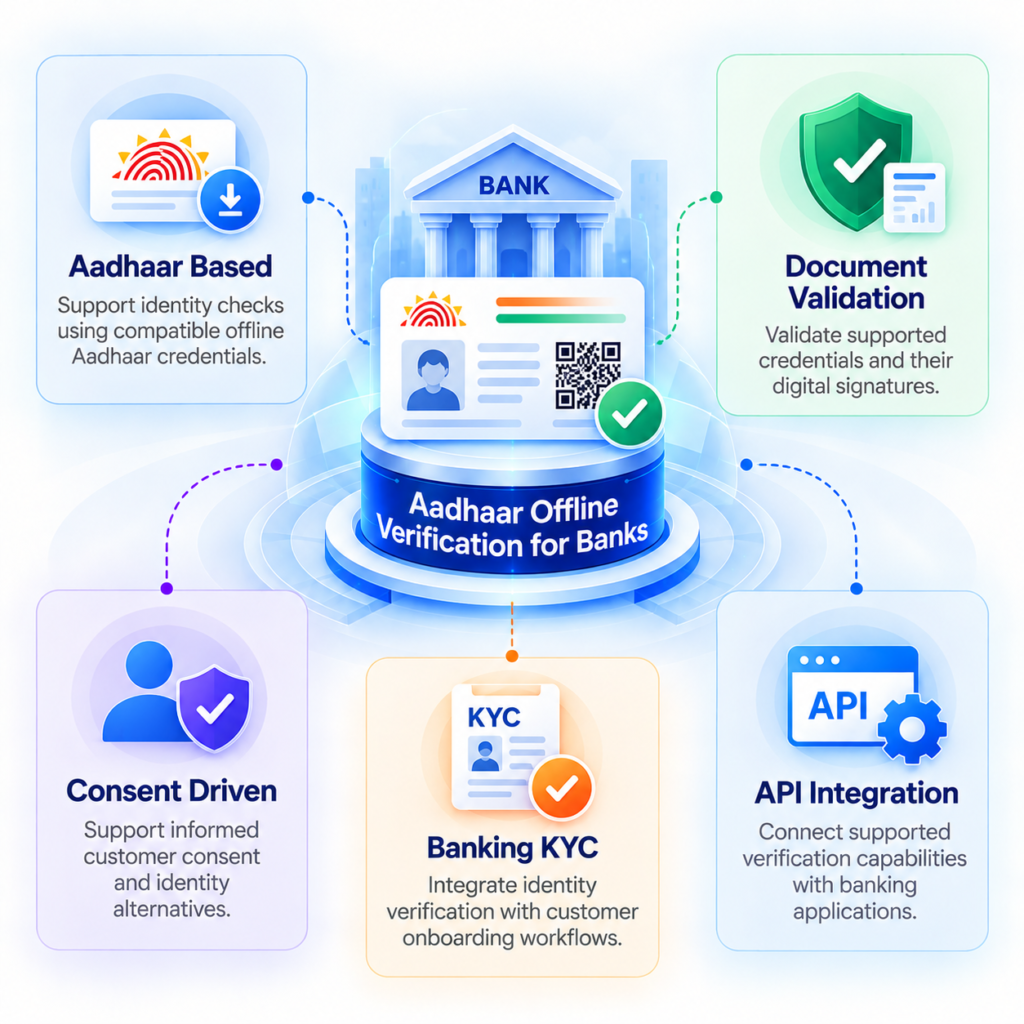
Aadhaar Offline Verification for Banks
Support privacy-conscious customer identity verification with compatible Aadhaar offline credentials. Integrate document validation, consent management and verification results into eligible banking and KYC workflows.
End-to-End Flow
1.
Initiate Customer Onboarding
Explain Verification Requirements
Capture Customer Consent
Receive Aadhaar Credentials
Validate the Document
Process Verification Results
Apply KYC Requirements
Complete the Onboarding Workflow
Key Capabilities
Aadhaar Offline Verification — Process supported offline Aadhaar credentials without a live UIDAI authentication query.
Secure QR Verification — Validate supported Aadhaar Secure QR Codes and their digital signatures.
Paperless Offline e-KYC — Process compatible, digitally signed offline e-KYC documents.
Consent Management — Capture the required consent and communicate the intended use of identity information.
Identity Data Extraction — Extract supported demographic information from compatible documents.
Verification Status Handling — Return supported verification outcomes to connected banking workflows.
Privacy-Conscious Processing — Minimize the collection and retention of Aadhaar-related information.
API Integration — Connect compatible verification functionality with customer onboarding and KYC systems.
Use Cases

Bank Account Onboarding
Support identity checks during eligible savings, current account and customer registration workflows.

Digital Lending
Support identity checks during eligible savings, current account and customer registration workflows.

KYC Operations
Integrate verified identity information into eligible KYC review and record-management processes.
Developer Experience
Suggested Input
The following is an illustrative application-level request, not an official UIDAI schema or confirmed FinAnalyz production contract.
{
"customer_reference": "CUST100001",
"verification_method": "AADHAAR_OFFLINE_XML",
"consent": true,
"document_reference": "DOC100001"
}
Suggested Output
{
"client_id": "FINXXXXXX",
"customer_reference": "CUST100001",
"document_reference": "DOC100001",
"signature_valid": true,
"verification_status": "VERIFIED",
"request_id": "KYC100001"
}
Actual fields and status values depend on the selected verification service and production implementation. Offline identity verification does not, by itself, satisfy every KYC or customer due diligence requirement.
Frequently Asked Questions
What is Aadhaar Offline Verification for Banks?
It is a process for verifying supported Aadhaar credentials locally, such as a Secure QR Code or Paperless Offline e-KYC document, without a live UIDAI authentication query.
How is offline verification different from Aadhaar authentication?
Offline verification validates supported credentials and their digital signature locally. Aadhaar authentication is a separate process involving an authorized requesting entity and an authentication query to UIDAI.
Is customer consent required?
Yes. Aadhaar offline verification requires informed consent and disclosure of the information being shared, its intended use and available alternatives.
What information can the bank receive?
Depending on the supported credential and customer-selected options, offline e-KYC may contain name, address, photograph, gender, date of birth or year of birth, a reference ID and hashed contact information.
Does offline verification replace all bank KYC requirements?
No. Banks must apply the relevant RBI KYC directions, customer due diligence requirements and any additional verification required for the account or service.
Can a bank integrate offline verification with its KYC system?
A compatible implementation can connect verification processing with KYC systems through supported interfaces. The bank must confirm the applicable UIDAI operating model and technical integration requirements.