
Aadhaar Paperless Offline e-KYC Digitize Aadhaar KYC with Paperless Offline e-KYC
The Aadhaar Paperless Offline e-KYC API enables businesses to verify Aadhaar identity using the digitally signed, encrypted offline e-KYC XML generated by an Aadhaar holder. The XML can contain identity information such as name, address, photograph, gender and date/year of birth, while mobile number and email may be represented in hashed form.
The solution is designed for organizations that need a paperless identity-verification workflow without relying on an online request to UIDAI’s central identity database. The Aadhaar holder downloads the offline e-KYC package and shares it with the authorized verification entity along with the Share Code required to open the protected file.
End-to-End Bank Statement Analytics Flow
Customer Initiates Offline e-KYC
Aadhaar Holder Generates the XML
XML Package Is Shared
XML Is Extracted
Digital Signature Is Validated
KYC Data Is Parsed
Optional Identity Checks
Verification Result Is Returned
Key Capabilities
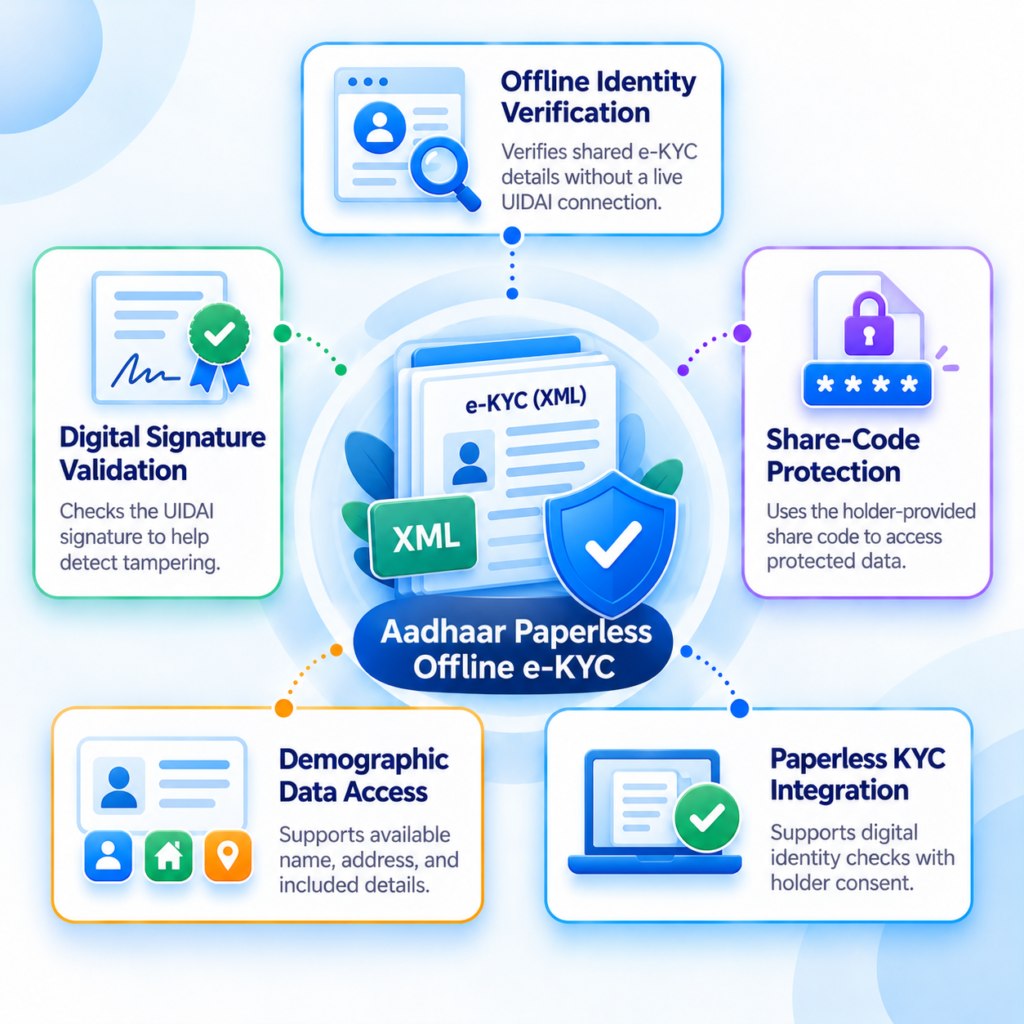
Offline XML Verification
Process Aadhaar Paperless Offline e-KYC XML without requiring an online Aadhaar authentication request to UIDAI’s central identity database.
Digital Signature Validation
Validate the digital signature embedded in the XML against the applicable UIDAI public certificate to identify authentic or tampered data.
Secure XML Extraction
Process the password-protected ZIP package using the Share Code supplied by the Aadhaar holder.
Demographic Data Extraction
Extract applicable identity attributes including name, address, gender and date/year of birth from the offline e-KYC document.
Photograph Extraction
The offline e-KYC XML can contain a photograph in encoded form that can be processed by the verification application.
Hashed Contact Verification
Where the relevant information is available, hashed mobile and email values can be validated against customer-provided contact information using the applicable UIDAI-defined process.
Reference-Based Identification
The offline e-KYC framework provides a reference ID containing the last four digits of the Aadhaar number and a timestamp rather than requiring the service provider to collect the complete Aadhaar number.
Use Cases

Banking & Account Opening
Banks can incorporate offline Aadhaar e-KYC into eligible customer onboarding processes where paperless identity verification is required.

NBFC & Lending
Lenders can use verified identity information as part of customer onboarding and loan-application workflows, subject to applicable KYC requirements.

Fintech Onboarding
Fintech platforms can integrate XML-based Aadhaar verification into digital customer registration and KYC workflows.
Developer Experience
Secure REST APIs with Aadhaar paperless offline e-KYC verification and structured JSON responses for seamless identity validation and digital onboarding.
REST API Integration
Connect the offline e-KYC verification capability with existing onboarding, KYC and customer-management applications through an API-based integration.
XML Processing
The integration is designed around the Aadhaar Offline e-KYC XML/ZIP workflow rather than an online Aadhaar-number authentication request.
Structured JSON
Transform applicable XML verification information into machine-readable JSON for easy consumption by enterprise applications.
Verification Status
Use the API response to determine whether the supplied offline e-KYC package passed the applicable validation process.
Enterprise Workflow Ready
Connect the verification result with LOS, LMS, CRM, onboarding, insurance or other eligible business systems.
Secure Data Handling
Aadhaar-related information is sensitive. Implement appropriate consent, access control, retention, encryption and audit controls in accordance with applicable Aadhaar requirements and organizational policies.
Suggested Input
Illustrative structure — exact FinAnalyz production schema may differ:
{
“reference_id”: “FIN-EKYC-XXXXXX”,
“xml_file”: “<BASE64_OR_FILE_REFERENCE>”,
“share_code”: “<CUSTOMER_SHARE_CODE>”,
“consent”: true
}
The exact FinAnalyz implementation may use multipart file upload, a file reference, encoded XML or another supported input mechanism. The production request schema should be defined in the API documentation.
Suggested Output
Illustrative structure — exact FinAnalyz production schema may differ:
{
“reference_id”: “FIN-EKYC-XXXXXX”,
“verification_status”: “VERIFIED”,
“signature_status”: “VALID”,
“name”: “<MASKED_NAME>”,
“date_of_birth”: “<YYYY-MM-DD>”,
“gender”: “<GENDER>”,
“address”: “<MASKED_ADDRESS>”,
“aadhaar_reference_id”: “XXXX-XXXXXXXXXXXX”,
“status”: “SUCCESS”
}
The exact response fields, Aadhaar reference format and returned attributes should be aligned with the FinAnalyz production schema and applicable UIDAI requirements.
Frequently Asked Questions
What is Aadhaar Paperless Offline e-KYC?
Aadhaar Paperless Offline e-KYC is a digitally signed, shareable electronic document that allows an Aadhaar holder to establish identity with a verification entity without relying on online Aadhaar authentication.
How does Aadhaar Offline e-KYC work?
The Aadhaar holder generates an offline e-KYC ZIP file through the UIDAI process, protects it with a Share Code and shares the file and code with the verification entity. The entity extracts the XML, validates its digital signature and processes the permitted identity information.
What information is available in the offline e-KYC XML?
Depending on the selected fields and current UIDAI format, the XML can include the resident's name and reference number, with optional address, photograph, gender, date/year of birth, hashed mobile number and hashed email.
Is the Aadhaar number shared with the verification entity?
The offline e-KYC framework is designed so that the service provider does not need to collect or store the full Aadhaar number; the XML uses a reference ID that includes the last four digits of the Aadhaar number along with a timestamp.
Is the offline e-KYC XML digitally signed?
Yes. UIDAI states that the XML is digitally signed, allowing the service provider to validate the signature and detect tampering.
Is customer consent required?
Yes. Aadhaar Paperless Offline e-KYC is voluntary and Aadhaar-holder driven. The individual chooses to share the generated e-KYC information with the service provider.
What is the Share Code?
The Share Code is the password/passphrase created by the Aadhaar holder when downloading the offline e-KYC package. It is required by the verification entity to extract the protected XML file.