
Aadhaar to Email API Verify Aadhaar-Linked Email Information Through an API
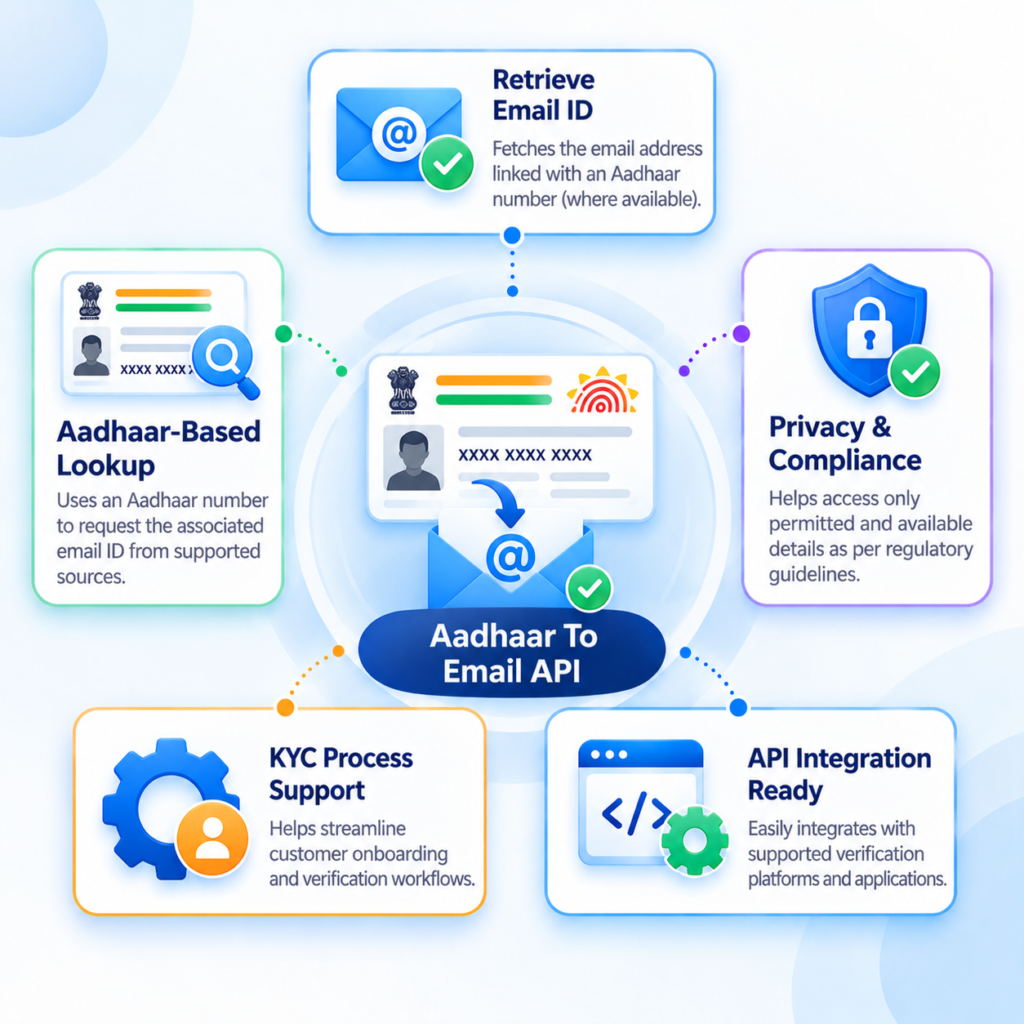
The Aadhaar to Email API enables businesses to verify customer email details associated with Aadhaar credentials through a supported, consent-based offline verification workflow. It helps improve contact information accuracy, streamline customer onboarding, and support digital communications across fintech, banking, digital lending, e-commerce, and other registration processes. The information available depends on customer consent, shared credentials, and the API integration.
End-to-End Flow
Initiate the Email Verification Request
Collect the Customer's Email Address
Present the Aadhaar Verification Journey
Obtain Customer Consent
Receive the Shared Credential
Validate the Available Email Information
Generate the Verification Result
Return the Result to the Business
Key Capabilities
Aadhaar-Linked Email Verification
Verify email-related information associated with an Aadhaar holder through the supported offline verification workflow.
Email Matching
Compare a customer-submitted email address against the information available through the selected verification method, where the implementation supports direct matching.
Offline Credential Validation
Process supported Aadhaar offline credentials and validate their digital signatures and integrity where applicable.
Consent-Based Data Sharing
Integrate customer authorization into the verification journey and limit information processing to the disclosed purpose.
Digital Onboarding Support
Incorporate email verification into registration, account opening, loan applications, and other customer onboarding journeys.
Structured Verification Results
Make verification outcomes available in a machine-readable format for business applications, subject to the production response schema.
Email Data Quality
Help identify potential discrepancies between customer-submitted email information and the information available through the supported verification process.
Workflow Integration
Connect verification outcomes to CRM platforms, KYC systems, customer databases, and email communication workflows.
Use Cases

Banking and Financial Services
Verify email-related information during eligible customer onboarding and account registration workflows.

Fintech and Digital Lending
Check customer-provided email information as part of loan application processing and digital onboarding.

E-commerce and Retail
Add an additional email verification step during customer registration to help identify mismatches in submitted contact information.
Developer Experience
Consent-based Aadhaar-linked email verification through secure REST APIs with structured JSON responses for seamless integration.
Simple API Integration
Connect the verification service to existing web applications, mobile apps, and backend systems through the documented FinAnalyz API interface.
Consent-Aware Verification
Design the integration around customer authorization and the permitted sharing of Aadhaar-related information.
Structured JSON Responses
Process the verification result in a machine-readable format for internal databases, onboarding platforms, and downstream applications.
Secure Credential Processing
Apply appropriate access controls, encryption, data minimization, and retention policies when handling identity and email information.
Business Workflow Integration
Connect verification results with KYC platforms, customer relationship management systems, loan origination systems, and notification services.
Verification Status Handling
Handle successful verification, mismatches, invalid credentials, and incomplete requests according to the statuses documented in the production API.
Suggested Input
Illustrative structure only — the exact FinAnalyz request schema must be confirmed. Depending on the implementation, the request may initiate a credential-sharing session rather than accept an Aadhaar number directly.
{
“reference_id”: “FIN-EMAIL-001”,
“email”: “customer@example.com”,
“verification_method”: “aadhaar_ovse”,
“consent”: true
}
Suggested Output
Illustrative structure only — these fields are examples, not confirmed production response fields.
{
“reference_id”: “FIN-EMAIL-001”,
“verification_status”: “VERIFIED”,
“email_match”: true,
“email”: “customer@example.com”,
“verification_method”: “aadhaar_ovse”,
“status”: “SUCCESS”
}
Implementation note: Confirm whether the production API returns the email address itself, a match result, or another verification outcome. UIDAI’s legacy offline XML format represents registered mobile and email information as hashes; an integration must not assume that the original email address can always be retrieved from that credential.
Frequently Asked Questions
What is the Aadhaar to Email API?
The Aadhaar to Email API is designed to verify or process email-related information associated with an Aadhaar holder through a supported Aadhaar offline verification workflow.
How does Aadhaar-to-email verification work?
The customer authorizes a supported verification journey, shares the required credential or information, and the verification service processes the available email-related data before returning the applicable result.
Can the API retrieve the complete email address linked to Aadhaar?
This depends on the verification method and the available data. UIDAI's legacy offline XML format contains a hashed representation of the registered email address rather than the original address in plain text. Therefore, retrieving a complete email address must not be assumed for every offline verification workflow.
Is customer consent required?
Yes. Aadhaar offline verification must follow the applicable UIDAI framework, including requirements concerning disclosure, consent, and the purpose for which information is processed.
What is the difference between Aadhaar to Email and Email Verification APIs?
An Aadhaar to Email API focuses on email information associated with Aadhaar credentials. A conventional Email Verification API may instead validate email syntax, domain or mail-server characteristics, or email ownership through other methods. These services are not interchangeable.
Who can use the Aadhaar to Email API?
Potential users include banks, fintech companies, lenders, insurance providers, e-commerce businesses, and other organizations with eligible identity verification requirements, subject to applicable registration and regulatory conditions.
Can the API be integrated into an existing KYC system?
Yes. The verification workflow can be incorporated into a broader KYC or customer onboarding application, provided the integration supports the required credential-sharing process and response format.