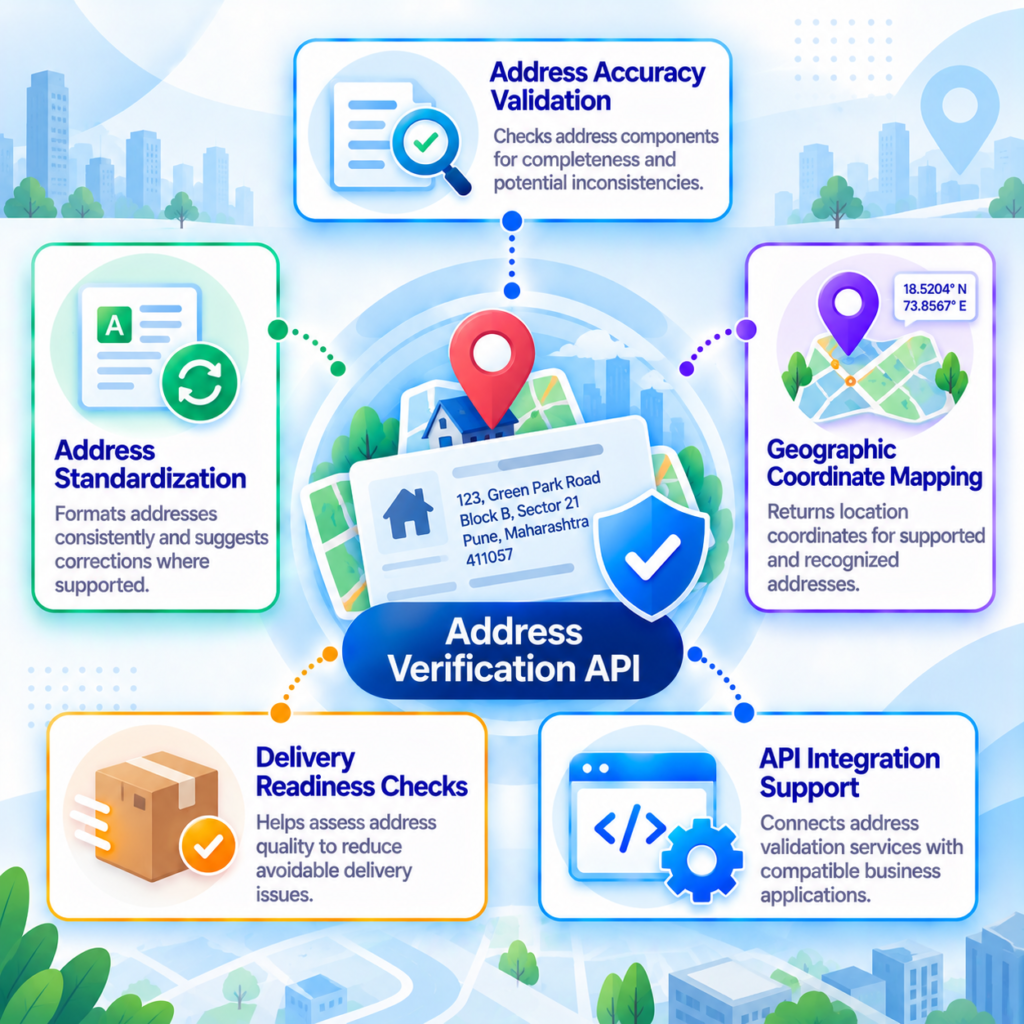
Address Verification API Simplify Address Validation with FinAnalyz APIs
The Address Verification API helps businesses verify and validate customer address details through supported digital verification workflows. It can help identify address discrepancies, improve record accuracy, and streamline KYC, customer onboarding, lending, financial services, and delivery-related processes, depending on the available data sources and API capabilities.
End-to-End Flow
Submit the Address
Validate the Request
Parse Address Components
Standardize the Address
Check Address Consistency
Retrieve Additional Address Information
Return the API Response
Complete the Business Workflow
Key Capabilities
Address Validation
Checks submitted address information using the validation methods and data sources available through the connected service.
Address Standardization
Converts supported address variations into a consistent format, helping maintain cleaner customer and business records.
Address Component Extraction
Separates a complete address into structured fields, such as building, street, locality, city, state, postal code, and country, where supported.
Postal Code and Locality Checks
Helps assess whether postal codes and locality information are consistent with the address data available to the service.
Missing Information Detection
Identifies address components that are missing, incomplete, or unresolved so the application can request corrections where necessary.
Geocoding Support
Can return geographic coordinates or location identifiers when the selected API supports geocoding alongside address validation.
Use Cases

Banking and Financial Services
Support address checks during customer onboarding and KYC processes, where permitted and appropriate. Address validation alone does not establish a customer's residential address or prove residency.

E-Commerce and Delivery
Help customers correct incomplete or inconsistently formatted delivery addresses before an order is processed, where the validation service supports the destination region.

Fintech and Digital Onboarding
Standardize address information submitted through registration forms and compare it with permitted records when the integration supports such checks.
Developer Experience
Secure REST APIs with address verification and structured JSON responses for seamless customer validation and accurate record management.
API-Based Integration
Connect the Address Verification API to an existing application using the endpoint, authentication method, and request format specified in the FinAnalyz documentation.
Flexible Address Inputs
Submit a complete address string or structured address components accepted by the selected endpoint.
Standardized Results
Process normalized address fields, validation indicators, missing components, or geographic information where these features are supported.
Address Correction Workflows
Use validation results to prompt users to correct incomplete or unresolved address information before completing a form or transaction.
Error Handling
Handle incomplete inputs, unsupported regions, authentication failures, unresolved addresses, and service errors according to the documented API behavior.
Secure Integration Practices
Use HTTPS where supported, protect API credentials, limit access to personal information, and avoid storing unnecessary address data.
Suggested Input JSON (Illustrative Only)
The following is a conceptual example, not a confirmed production request schema. Actual field names and required address components depend on the selected endpoint.
{
"address": {
"address_line1": "<BUILDING_AND_STREET>",
"locality": "<LOCALITY_OR_CITY>",
"state": "<STATE>",
"postal_code": "<POSTAL_CODE>",
"country": "IN"
}
}
Suggested Output JSON (Illustrative Only)
This example demonstrates a possible response structure only. Actual fields, validation statuses, and geographic information must be confirmed in the FinAnalyz API documentation.
{
"success": true,
"message": "Address validation processed",
"data": {
"validation_status": "<STATUS>",
"formatted_address": "<STANDARDIZED_ADDRESS>",
"missing_components": [],
"geocode": {
"latitude": "<LATITUDE_OR_NOT_AVAILABLE>",
"longitude": "<LONGITUDE_OR_NOT_AVAILABLE>"
}
}
}
Important Integration Note: Confirm the production endpoint, supported countries and regions, accepted address fields, validation source, authentication requirements, response schema, and error codes before implementation. A standardized or geocoded address is not necessarily proof that a person lives at that location. If you need proof of residence, use an appropriate authorized verification method in addition to basic address validation.
Frequently Asked Questions
What is an Address Verification API?
An Address Verification API helps applications validate, standardize, or check address information using the methods supported by the connected service. It may also return structured address components or geographic information where available.
What information is required for address verification?
The required inputs depend on the API endpoint. A service may accept a complete address, or separate fields such as street, locality, city, state, postal code, and country.
Can the API correct an incorrectly formatted address?
Some address validation services can standardize formatting and correct supported errors. They may also identify missing or unresolved components, but they cannot guarantee that every submitted address can be corrected.
Can the API verify Indian addresses?
Some providers support Indian address validation and standardization. Coverage and accuracy vary, so confirm the provider's current support for Indian states, localities, and postal codes before integration.
Does address verification confirm that a person lives at the address?
No. Address validation may check formatting, components, geographic resolution, or consistency with available reference data. Proof of residence requires an appropriate additional verification method.
Can the API return latitude and longitude?
Some address services include geocoding and return geographic coordinates or location identifiers. This feature depends on the selected API and the address's geographic coverage.