
Finanalyz

Hyderabad info@finanalyz.com

AI-Powered Name Match API Make Identity Matching Smarter with AI-Powered Name Matching

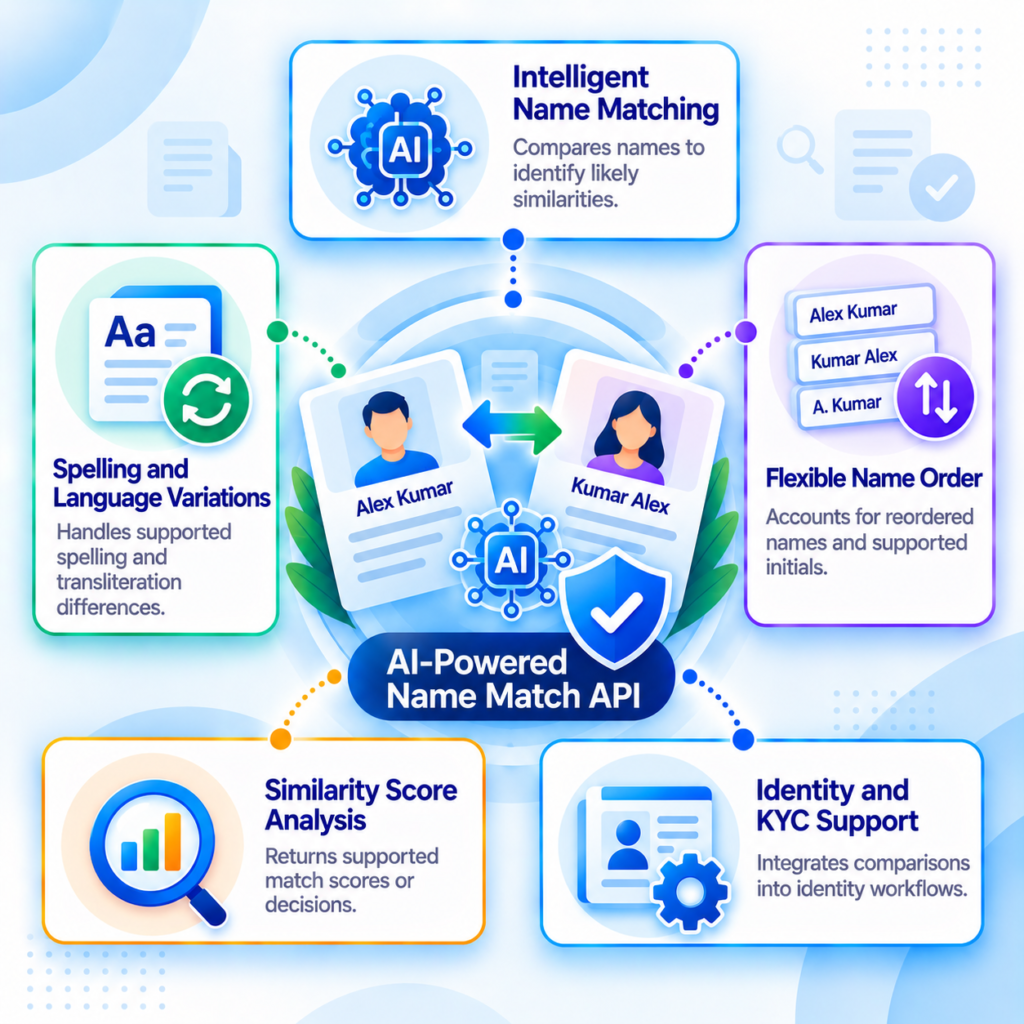
The AI-Powered Name Match API uses intelligent matching techniques to compare names across different records, accounting for spelling variations, formatting differences, and similar name patterns. It helps businesses improve identity verification, detect potential mismatches, streamline KYC, and enhance customer onboarding across financial services and other industries.


End-to-End Flow

1

Submit Name Information

2

Validate the Request

3

Normalize the Input Data

4

Analyze Name Variations

5

Evaluate Additional Attributes

6

Generate a Match Assessment

7

Apply Business Rules

8

Complete the Verification Workflow

Key Capabilities

AI-Assisted Name Matching
Uses the matching techniques supported by the service to assess potential similarities between names that may not match exactly.

Fuzzy and Approximate Matching
Helps identify likely matches despite spelling mistakes, character differences, abbreviations, or variations in name formatting where supported.

Intelligent Name Normalization
Can standardize capitalization, punctuation, spacing, and common prefixes before comparison, depending on the implementation.

Multi-Attribute Record Matching
Where supported, evaluates names alongside additional permitted attributes to help determine whether records may refer to the same individual.

Similarity and Confidence Scoring
Returns a score or confidence indicator where available, helping applications prioritize likely matches and uncertain comparisons.

Configurable Matching Thresholds
Supports configurable decision thresholds where provided by the API, allowing businesses to define when a result should be accepted or reviewed.

Automated Duplicate Detection
Helps identify potentially duplicated customer or identity records across systems for further investigation or reconciliation.

Integration with Verification Systems
Connects supported AI-powered matching functions with KYC, onboarding, bank account validation, payment processing, and customer data management workflows.

Use Cases

KYC and Identity Verification

Compare names submitted by customers with names returned by authorized identity verification services. AI-assisted matching can help identify potential matches despite spelling or formatting differences.

data_aggregation

Bank Account and Payout Validation

Compare a beneficiary's declared name with an account-holder name returned by a supported bank verification service before processing payments.

categorization

PAN, Aadhaar, and Document Reconciliation

Help reconcile names across identity documents and application records, subject to authorized access and applicable requirements.

Developer Experience

Secure REST APIs with AI-powered name matching and structured JSON responses for accurate identity verification and seamless data validation.

API-Based Integration

Connect the AI-Powered Name Match API to an existing application using the endpoint, authentication method, and request format specified in the FinAnalyz documentation.

Flexible Input Fields

Submit the names to compare and additional permitted attributes where the selected endpoint supports multi-attribute matching.

AI-Assisted Matching Results

Retrieve the supported match decision, similarity score, confidence indicator, or explanation of differences where available.

Configurable Decision Rules

Apply matching thresholds or business rules where supported to determine whether a result can proceed automatically or requires manual review.

Error Handling

Handle missing fields, invalid requests, authentication failures, rate limits, and service errors according to the documented API behavior.

Secure Integration Practices

Use HTTPS where supported, protect API credentials, restrict access to personal information, and avoid retaining unnecessary identity data.

Suggested Input JSON (Illustrative Only)

The following is a conceptual example, not a confirmed production request schema. The additional attributes and field names depend on the capabilities of the selected endpoint.

{
  "name1": "S. Kumar",
  "name2": "Suresh Kumar",
  "date_of_birth1": "<YYYY-MM-DD>",
  "date_of_birth2": "<YYYY-MM-DD>"
}

Suggested Output JSON (Illustrative Only)

This example illustrates a possible response structure only. The fields, scoring scale, and result values must be confirmed in the FinAnalyz API documentation.

{
  "success": true,
  "message": "Matching analysis completed",
  "data": {
    "match": "<TRUE_FALSE_OR_REVIEW>",
    "confidence_score": "<SCORE>",
    "matching_method": "<METHOD>",
    "explanation": "<MATCHING_RESULT_SUMMARY>"
  }
}

Important Integration Note: Confirm the production endpoint, supported AI or matching methods, accepted inputs, scoring interpretation, threshold behavior, authentication requirements, and response schema before implementation. AI-assisted matching does not necessarily mean the service accesses external identity databases. A confidence score is not automatically a probability that two records belong to the same person. Use additional authorized verification signals and human review for ambiguous or high-risk cases.

Frequently Asked Questions

What is an AI-Powered Name Match API?

An AI-Powered Name Match API compares names and estimates whether they may refer to the same person. Depending on the service, it may account for spelling variations, initials, transliteration, and additional identity attributes.

Standard name matching may rely on exact comparisons or predefined similarity rules. AI-powered systems can use machine-learning models and additional context to assess less obvious variations, depending on their implementation.

It may identify likely matches despite spelling mistakes, abbreviations, or formatting differences when these variations are supported by the matching engine.

Some services support multilingual names and transliteration between scripts. This capability depends on the model, supported languages, and endpoint configuration.

Some AI-powered matching services return a confidence or similarity score. The scale, interpretation, and availability of that score depend on the specific API.

Some implementations support matching multiple attributes, such as name, date of birth, address, or contact information. Only submit additional fields if the selected endpoint supports them and their use is authorized.

Still have any question? Please contact our sales team