Finanalyz

Hyderabad info@finanalyz.com

CRILC Data API Access CRILC Credit Information Through an API

Retrieve structured CRILC-related borrower credit information to support credit assessment, lending decisions, risk monitoring, and financial due diligence through a developer-friendly API.

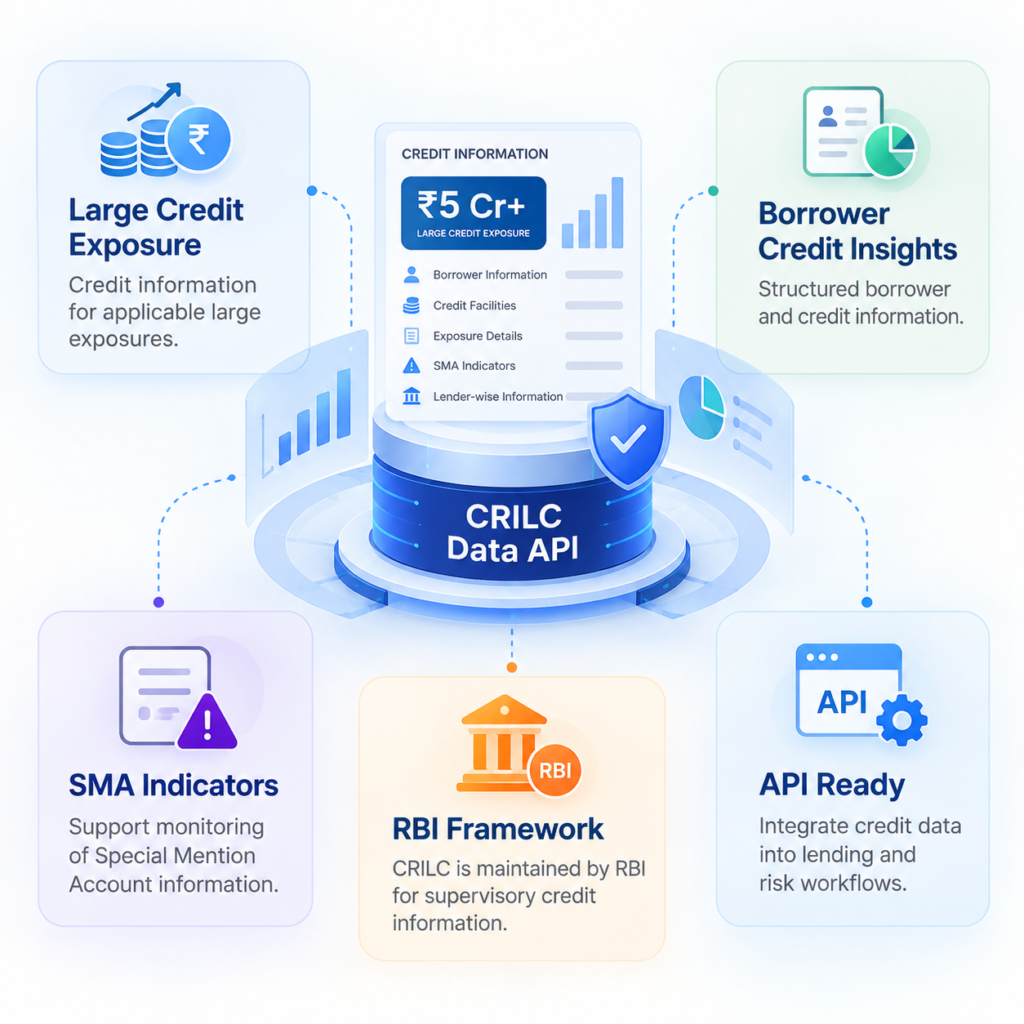
CRILC (Central Repository of Information on Large Credits) is an RBI repository used for collecting and disseminating information on large credit exposures. RBI’s current reporting framework covers borrowers with aggregate fund-based and non-fund-based exposure of ₹5 crore and above for applicable reporting entities.

End-to-End Flow

1

Submit Borrower Details

2

Validate Request

3

Retrieve CRILC Information

4

Process Credit Data

5

Generate CRILC Report

6

Analyze Credit Exposure

7

Integrate Into Workflow

Key Capabilities

Borrower Credit Information

Retrieve available CRILC-related information associated with the borrower.

Large Credit Exposure

Access reported information relating to significant credit exposures.

SMA Information

Support workflows that need Special Mention Account indicators and related credit-status information.

Structured Credit Data

Receive information in a machine-readable format suitable for automated processing.

Credit Risk Assessment

Use CRILC information as one input into borrower and credit-risk evaluation.

Portfolio Monitoring

Integrate CRILC-related information into ongoing borrower and portfolio monitoring workflows.

Bulk Processing

Support high-volume borrower checks where bulk processing is enabled.

API Integration

Integrate directly with lending, underwriting, compliance, and risk-management platforms.

Use Cases

Digital Lending & Underwriting

Use borrower credit information as part of loan assessment and underwriting workflows.

data_aggregation

Credit Risk Assessment

Support credit teams in reviewing reported large-credit exposures and related indicators.

categorization

Corporate Lending

Strengthen borrower due diligence for business and corporate lending.

Developer Experience

Simple API Integration

Connect through standard API requests and receive structured JSON responses.

Machine-Readable Data

Designed for easy processing by lending, risk, and financial applications.

Secure Processing

Build CRILC data retrieval into controlled and authenticated financial workflows.

Workflow Ready

Integrate with existing LOS, LMS, underwriting, CRM, and risk engines.


Suggested Input

Illustrative structure replace with your production schema if different.

{
  "pan_number": "ABCDE1234F",
  "mobile_number": "98XXXXXX21"
}

Suggested Output

Illustrative response structure.

{
  "client_id": "FINXXXXXX",
  "pan_number": "ABCDE1234F",
  "borrower_name": "XXXXXXXX",
  "credit_exposure": "XXXXXXXX",
  "exposure_status": "AVAILABLE",
  "sma_status": "NO_SMA",
  "reporting_status": "REPORTED",
  "verification_status": "SUCCESS"
}

Note: Exact fields and values should follow the actual CRILC API response schema available in your FinAnalyz implementation.

Frequently Asked Questions

What is the CRILC Data API?

The CRILC Data API is designed to provide structured access to available CRILC-related borrower credit information for financial assessment and risk workflows.

CRILC stands for Central Repository of Information on Large Credits. RBI established CRILC to collect, store, and disseminate information on large credit exposures and support supervisory and credit-risk processes.

Depending on the available data and API implementation, the response can include borrower information, reported credit exposure, credit-status indicators, and other relevant CRILC-related information.

CRILC-related information can support banks, NBFCs, lenders, fintech companies, credit teams, and financial institutions in applicable credit and risk-management workflows.

Yes. CRILC information can be incorporated as one source of information in borrower assessment, credit underwriting, risk monitoring, and due-diligence workflows. RBI has described CRILC as supporting the collection and dissemination of borrower credit-exposure information.

No. CRILC reporting is focused on applicable large-credit exposures. RBI's current reporting framework identifies ₹5 crore and above as the threshold for the relevant CRILC reporting returns.

Yes. The API can be integrated into loan origination, underwriting, risk assessment, and loan-management workflows.

Still have any question? Please contact our sales team