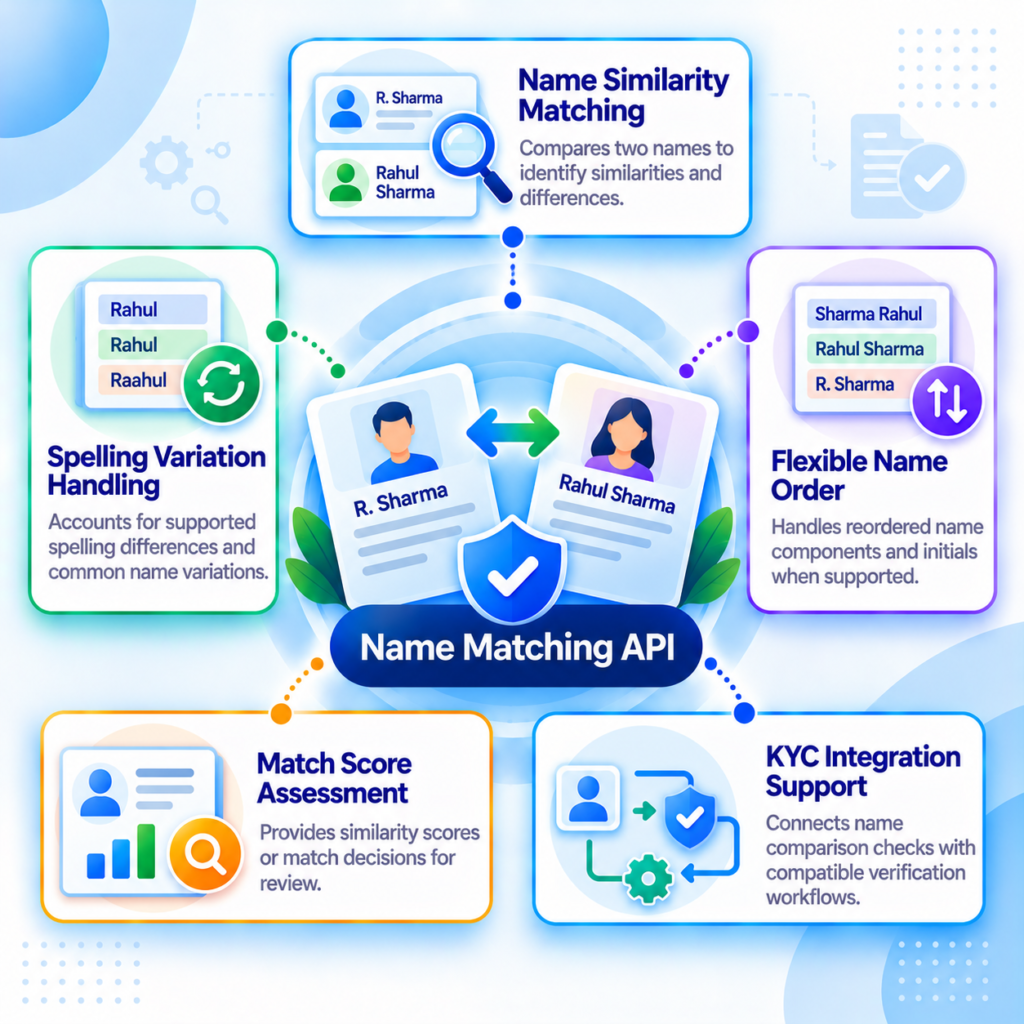
Name Matching API Simplify Identity Checks with the Name Matching API
The Name Matching API helps businesses compare names from different sources to determine whether they match or identify potential discrepancies. It supports identity verification, KYC, customer onboarding, financial transactions, and record validation by helping detect spelling variations, formatting differences, and similar names.
End-to-End Flow
Submit the Names
Validate the Request
Normalize the Names
Compare Name Variations
Calculate the Similarity Score
Apply the Matching Threshold
Return the API Response
Complete the Verification Workflow
Key Capabilities
Fuzzy Name Matching
Compares names that may differ slightly in spelling or formatting, helping identify potential matches that exact string comparison could miss.
Name Normalization
Standardizes supported text variations, such as capitalization, spaces, punctuation, and titles, before comparing names.
Similarity Score Generation
Returns a numerical similarity score where supported, helping applications assess how closely two names correspond.
Configurable Match Thresholds
Allows applications to define a score threshold where the API supports this feature, enabling matching rules to reflect different business requirements.
Initials and Abbreviation Handling
Can support variations involving initials or common abbreviations when the connected matching engine is designed to recognize them.
Name Order and Spelling Variation Handling
May identify potential matches when name components appear in a different order or contain supported spelling differences.
Structured Matching Results
Returns the match decision, similarity score, and other available fields in the API’s documented response format.
Integration with Verification Workflows
Connects name comparison with KYC, customer onboarding, bank account checks, payment processing, and duplicate-record detection systems.
Use Cases

KYC and Identity Verification
Compare names submitted by customers with names returned by supported identity verification services to help identify discrepancies during onboarding.

Bank Account Name Matching
Compare a beneficiary's submitted name with an account-holder name returned by an authorized bank verification service before processing a payment.

PAN and Aadhaar Data Reconciliation
Support comparison of names from different identity records where the relevant information has been lawfully obtained and the comparison is permitted.
Developer Experience
Secure REST APIs with intelligent name matching and structured JSON responses for seamless identity verification and data validation.
API-Based Integration
Connect the Name Matching API to an existing application using the endpoint, authentication method, and request format specified in the FinAnalyz documentation.
Simple Name Inputs
Submit the two names accepted by the selected endpoint, typically a source name and a target name.
Flexible Matching Rules
Configure thresholds or matching options where supported by the connected service.
Structured Response Handling
Process the similarity score, match classification, and available normalized values according to the documented response schema.
Error Handling
Handle missing names, invalid request formats, authentication failures, rate limits, and service errors according to the API documentation.
Secure Integration Practices
Use HTTPS where supported, protect API credentials, restrict access to personal information, and avoid retaining unnecessary name-comparison data.
Suggested Input JSON (Illustrative Only)
The following example is conceptual, not a confirmed production request schema. Actual field names and optional parameters must be confirmed in the FinAnalyz API documentation.
{
"name1": "Ramesh Kumar",
"name2": "Ramesh K.",
"threshold": 80
}
Suggested Output JSON (Illustrative Only)
This example demonstrates a possible response structure only. The score, matching behavior, and response fields shown are illustrative and are not guaranteed API results.
{
"success": true,
"message": "Name comparison completed",
"data": {
"similarity_score": "<SCORE>",
"match": "<TRUE_OR_FALSE>",
"threshold": 80,
"match_type": "<MATCH_TYPE>"
}
}
Important Integration Note: Confirm the production endpoint, supported algorithms, scoring range, threshold behavior, authentication requirements, response fields, and error codes before implementation. A high similarity score does not prove that two names belong to the same person. For higher-confidence identity checks, combine name matching with other authorized attributes or verification results where appropriate, and provide manual review for ambiguous cases.
Frequently Asked Questions
What is a Name Matching API?
A Name Matching API compares two names and determines how closely they match. Depending on the service, it may return a similarity score, a match decision, or additional information about the comparison.
How does name matching work?
A matching engine may normalize the submitted names and compare them using exact, fuzzy, phonetic, or other supported algorithms. The method used depends on the API implementation.
Can the API match names with spelling mistakes?
It may identify likely matches despite minor spelling differences if the matching algorithm supports fuzzy comparison. The result depends on the names, algorithm, and configured threshold.
Can the API handle initials and different name orders?
Some matching services support initials, abbreviations, and reordered name components. Confirm these capabilities in the selected API's documentation rather than assuming every engine supports them.
What is a name similarity score?
A similarity score represents how closely two names match according to the API's algorithm. Some services use a 0–100 scale, but the scoring range and interpretation depend on the provider.
What is a matching threshold?
A matching threshold is the score required for a comparison to be classified as a match when the API supports threshold-based decisions. Businesses should select thresholds based on their use case and test results rather than assuming one value suits every workflow.