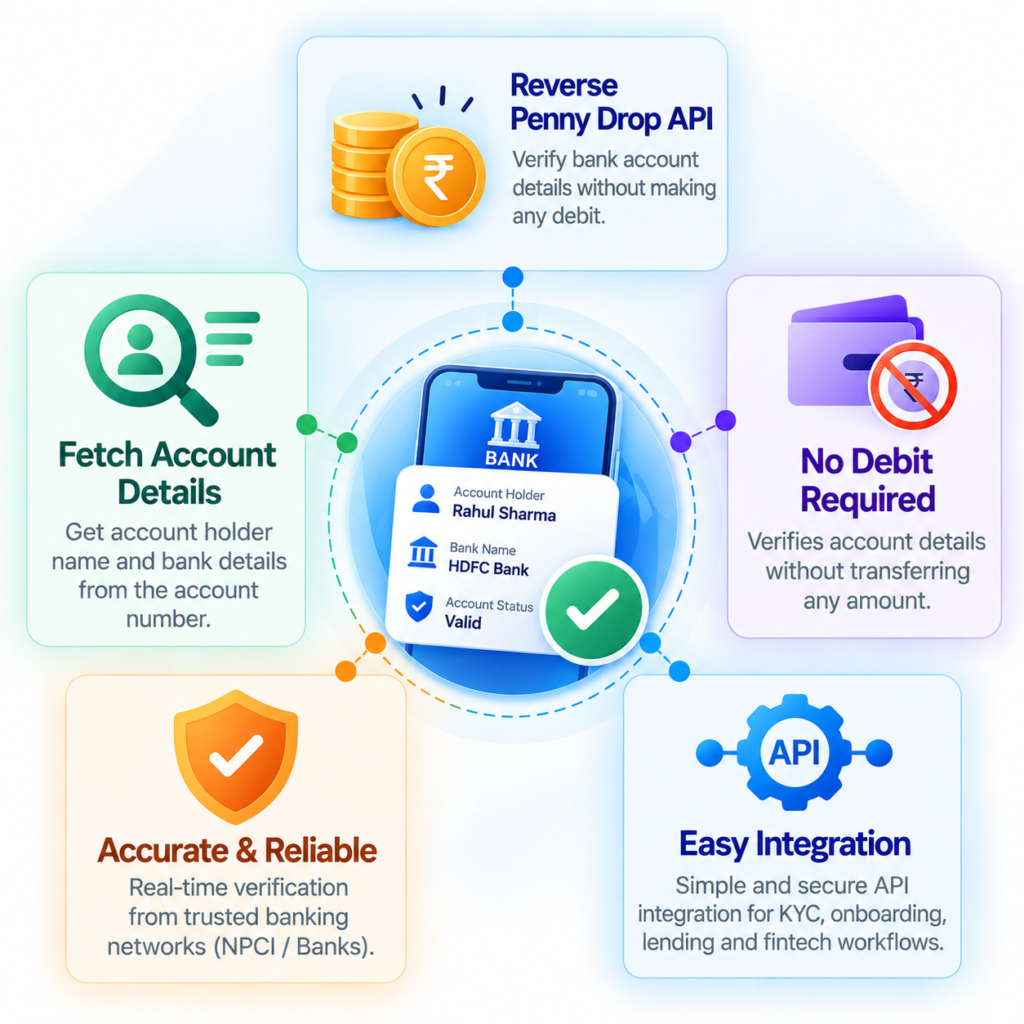
Reverse Penny Drop API Verify Bank Account Ownership Through a ₹1 UPI Transaction
Enable secure bank account verification by allowing users to initiate a nominal ₹1 UPI payment from the account they want to verify. Retrieve bank account details and account-holder information to support onboarding, payouts, lending, and financial verification workflows.
End-to-End Flow
Initiate Verification
Generate Payment Link
Customer Makes ₹1 Payment
Process the Transaction
Retrieve Bank Details
Receive Verification Result
Complete Your Workflow
Key Capabilities
₹1 UPI-Based Verification
Verify an account through a user-initiated nominal UPI transaction rather than sending money to the customer’s account.
Account Ownership Validation
Use the transaction to help establish that the customer has access to the bank account being verified.
Bank Account Details
Retrieve available bank account information such as:
-
Account Number
-
IFSC
-
Account Holder Name
-
Bank Name
-
UPI ID
-
Account Type
The exact fields depend on the API implementation.
Name Matching
Use the returned account-holder name for customer-to-bank-record matching where supported.
Real-Time Verification Status
Track whether the verification is successful, pending, failed, or expired.
Webhook Notifications
Receive verification events asynchronously through webhooks instead of continuously polling the API.
Automated Refund
Depending on the implementation, the nominal verification amount can be refunded after successful verification.
Use Cases

Digital Lending
Verify the borrower's payout account before loan disbursal.

Payouts & Vendor Payments
Businesses can verify beneficiary accounts before making payments.

Investment & Financial Platforms
Use bank account verification during onboarding and withdrawal workflows.
Developer Experience
Simple Integration. Verified Bank Account Data.
Suggested Input
{
"reference_id": "RPD_100001"
}
Suggested Output
{
"client_id": "FINXXXXXX",
"reference_id": "RPD_100001",
"status": "SUCCESS",
"bank_account_number": "XXXXXXXXXXXX",
"ifsc": "HDFC0001234",
"account_holder_name": "RAHUL SHARMA",
"bank_name": "HDFC BANK",
"upi_id": "customer@upi",
"verification_status": "VERIFIED"
}
Related APIs
Frequently Asked Questions
What is a Reverse Penny Drop API?
A Reverse Penny Drop API is a bank-account verification method where the customer initiates a nominal payment, typically ₹1, from the account they want to verify. The transaction is then used to retrieve and validate bank-account information.
How is Reverse Penny Drop different from Penny Drop?
In a traditional Penny Drop, the business sends a small amount to the customer's bank account. In Reverse Penny Drop, the customer initiates the small payment from their own bank account to the designated verification destination.
Why is a ₹1 transaction used?
The nominal transaction provides a mechanism to link the customer's initiated payment with the bank account being verified. The amount may subsequently be refunded depending on the implementation.
What bank details can be retrieved?
Depending on the API implementation, the response may include: Account Number IFSC Account Holder Name Bank Name UPI ID Account Type Verification Status
Is UPI required for Reverse Penny Drop?
A UPI-based Reverse Penny Drop flow generally requires the customer to make the verification payment using a UPI-enabled account/app. Alternative bank-account verification methods can be used for accounts that cannot complete a UPI flow.
Can Reverse Penny Drop be used for loan disbursal?
Yes. It can be incorporated into lending workflows to verify the account intended to receive loan funds before disbursal.
Can it be used for vendor payments?
Yes. Businesses can use bank-account verification during vendor onboarding and before processing payments.
Does the API support webhooks?
Reverse Penny Drop integrations can use webhooks to receive transaction and verification status updates asynchronously.
Still have any question? Please contact our sales team
Integrate FinAnalyz APIs into your workflows and access structured data, verification, and analytics through a simple, developer-friendly integration.