
- May 9, 2026
- Posted by: Finanalyz
- Category: Financial Analytics

In the world of finance, decisions are only as good as the data behind them. Bank statements hold a wealth of information about income patterns, spending behavior, liabilities, and financial discipline yet extracting meaningful insights from them remains a major challenge for financial institutions, lenders, and NBFCs across India.
The Challenge: When Financial Data Becomes a Bottleneck
Bank statements come in different formats depending on the financial institution. They often contain complex transaction narrations, inconsistent structures, and large volumes of data.
For credit analysts and underwriters, manually reviewing these statements involves:
- Identifying income sources
- Tracking recurring expenses
- Analyzing liabilities and obligations
- Evaluating account balances
- Detecting unusual financial behavior
This process is time-consuming and prone to human error. Even minor mistakes can impact credit evaluations, underwriting decisions, and risk assessments.
As loan volumes continue to grow, manual analysis becomes a major operational bottleneck.
From Manual Review to Intelligent Automation
Financial institutions are increasingly adopting automated Bank Statement Analysis solutions to improve efficiency and accuracy.
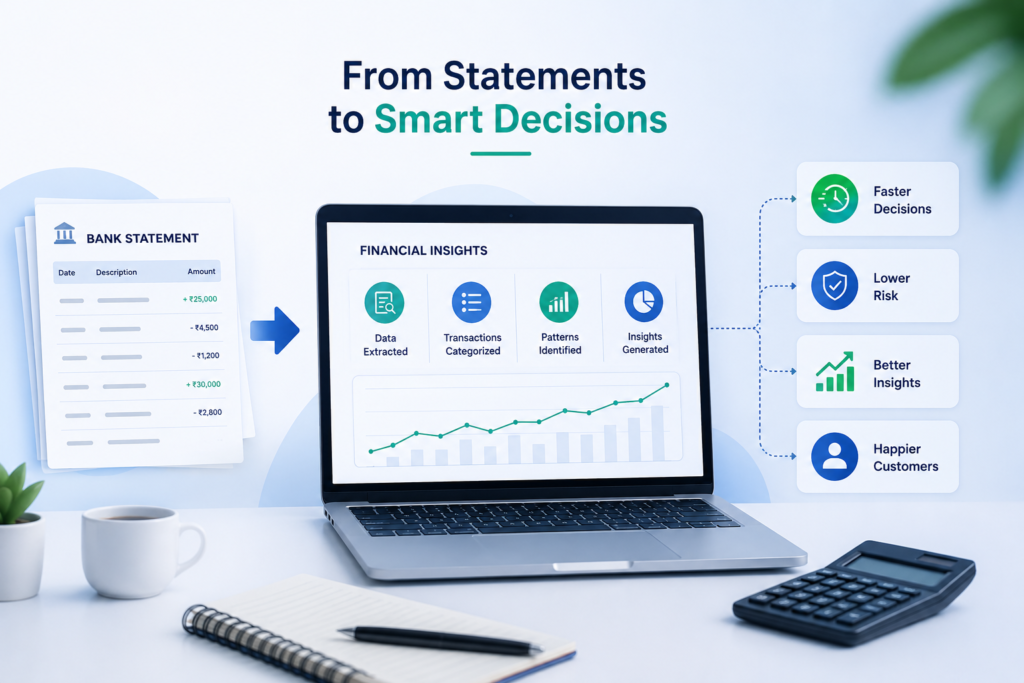
Advanced systems can automatically:
- Extract data from bank statements
- Categorize transactions
- Identify income and expense patterns
- Calculate financial metrics
- Generate detailed analysis reports
Instead of spending hours reviewing documents manually, analysts receive structured insights within seconds.
This automation helps lenders gain a complete understanding of a borrower’s financial behavior while significantly reducing processing time.
Key Benefits of Automated Analysis
Faster Processing
Analyze hundreds of transactions instantly without manual effort.
Improved Accuracy
Reduce errors associated with manual data entry and interpretation.
Better Risk Assessment
Identify financial trends, liabilities, and repayment capacity more effectively.
Consistent Decision-Making
Apply standardized evaluation criteria across all applications.
The Future of Bank Statement Analysis
As lending becomes increasingly digital, traditional document reviews are no longer sufficient.
Artificial intelligence and machine learning are transforming how financial institutions analyze customer data. Modern Bank Statement Analysis solutions can identify behavioral patterns, predict risks, and uncover insights that would be difficult to detect manually.
Organizations that embrace intelligent financial analysis tools can:
- Scale lending operations efficiently
- Improve underwriting accuracy
- Reduce operational costs
- Enhance customer experience
- Strengthen risk management frameworks
Bank statement analysis is no longer just an operational process it has become a strategic business advantage.
How Bank Statement Analysis Improves Credit Decisions
Effective lending depends on accurate financial evaluation.
By automating bank statement analysis, financial institutions can:
Assess Income Stability
Verify income consistency and identify salary or business cash flow patterns.
Evaluate Spending Behavior
Understand recurring expenses and financial discipline.
Detect Financial Risks
Identify overdrafts, bounced transactions, and irregular account activity.
Improve Credit Assessment
Use real financial behavior instead of relying solely on credit scores.
Accelerate loan processing and approval workflows.
The result is faster, more informed, and more confident lending decisions.
Conclusion
Manual analysis of financial documents is no longer sustainable in today’s competitive lending environment.
Automated Bank Statement Analysis enables financial institutions to unlock valuable insights, improve operational efficiency, reduce risk, and make smarter credit decisions faster than ever before.
For banks, NBFCs, and digital lenders, bank statement analysis is not simply a back-office function it is a critical driver of business growth, customer satisfaction, and lending success.
Transform the way you evaluate financial data with FinAnalyz’s intelligent Bank Statement Analysis solutions.
