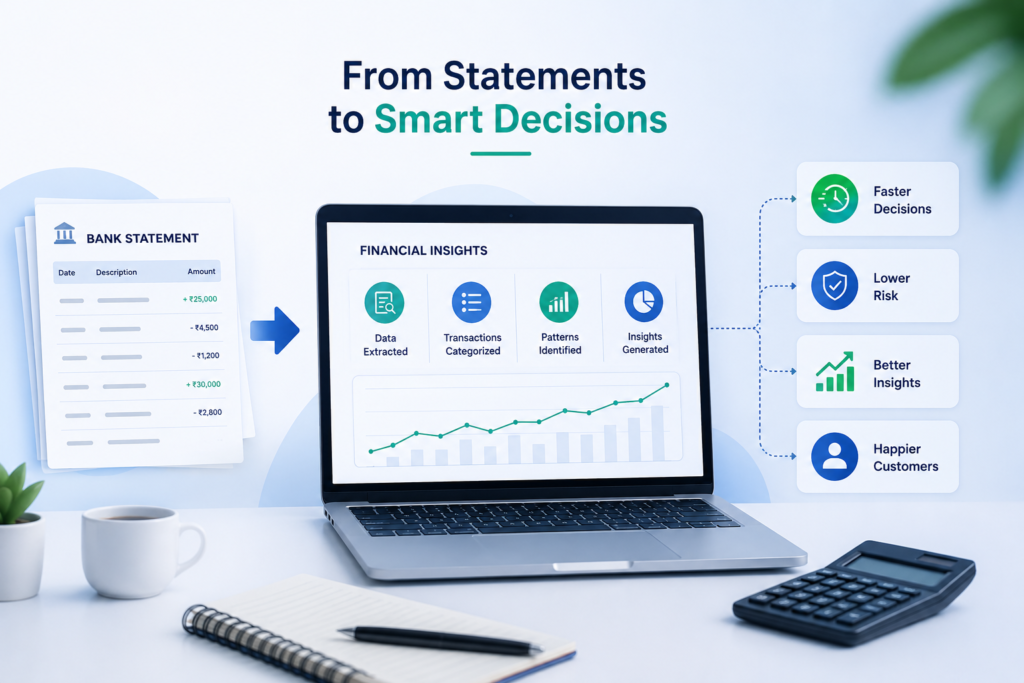
Turn Bank Statements intoSmart Decisions

In the world of finance, decisions are only as good as the data behind them. Bank statements hold a wealth of information about income patterns, spending behavior, liabilities, and financial discipline yet extracting meaningful insights from them remains a major challenge for financial institutions, lenders, and NBFCs across India.

The Challenge: When Financial Data Becomes a Bottleneck

Financial institutions deal with hundreds of statements daily. Each document arrives in a different format, with varied transaction descriptions and inconsistent structures. What should be a straightforward analysis often turns into a time-consuming and error-prone process.

The core friction points that slow down financial evaluation:

Non-Standardized Formats

Each bank uses different layouts, narrations, and structures making uniform processing nearly impossible manually

Manual Transaction Review

Analysts must go through each entry individually, dramatically slowing down operations and increasing costs

Risk of Human Error

Even small oversights in evaluation can lead to flawed credit decisions, compliance gaps, and financial loss

Slow Turnaround Time

In a fast-moving lending ecosystem, manual delays become a serious competitive and operational limitation

The Shift: From Manual Effort to Intelligent Automation

To overcome these challenges, financial institutions are increasingly turning to automated bank statement analysis. Instead of manually reviewing documents, advanced systems instantly extract data, structure transactions, and categorize financial information delivering results in seconds.

This transformation allows organizations to move from raw financial data to actionable insights without delays. Income, expenses, liabilities, and behavioral trends become clear and easy to interpret all within a single, streamlined view.

What Automation Delivers That Manual Review Cannot:

The result is not just speed it's a fundamental improvement in accuracy, consistency, and efficiency across every analysis.

Instant Data Extraction
Transaction Categorization
Pattern Recognition
Consistent Logic
Zero Manual Effort

How Automated Bank Statement Analysis Works

Modern automated analysis platforms process financial documents end-to-end from raw input to structured insight using AI and machine learning at every stage:

01
Intelligent Data Extraction
Parse any format, any bank, instantly

AI-powered parsers handle statements from any bank in any format PDF, Excel, or scanned extracting all transactions accurately without manual template configuration.

Multi-format parsingAll banks supportedZero setup
02
Transaction Categorization
Every entry classified and structured automatically

Each transaction is automatically categorized salary credits, EMI debits, utility payments, loan repayments, business income, and more giving analysts a clean, structured financial picture instantly.

Income taggingExpense mappingEMI detection
03
Cash Flow & Pattern Analysis
Behavioral and financial trends surfaced automatically

Beyond categorization, the system identifies recurring patterns inflow stability, expenditure cycles, balance behavior, and repayment consistency giving lenders a behavioral lens on borrower risk.

Cash flow mappingTrend detectionRisk signals
04
Automated Financial Summaries
Underwriting-ready reports in seconds

Structured financial summaries average monthly income, obligation-to-income ratio, net cash position, and key risk flags are generated automatically, ready for underwriting decisions without any manual compilation.

Instant reportsUnderwriting-readyRisk flags

The Impact: Smarter and Faster Credit Decisions

The real power of automated financial analysis lies in what it enables at the decision-making level. With structured insights, lenders can evaluate borrower credibility with far greater confidence:

Deeper Borrower Understanding

Cash flow analysis reveals financial stability far beyond what basic documentation can show

Obligation Visibility

Recurring transactions highlight existing EMIs and liabilities, giving a true picture of repayment capacity

Standardized Evaluation

Every statement is analyzed using identical logic, eliminating bias and ensuring consistent credit assessment

Better Customer Experience

Faster processing means quicker approvals and responses directly improving borrower satisfaction

In a competitive financial services industry, this combination of speed and precision creates a significant and sustainable advantage for forward-thinking lenders.

Key Benefits for Financial Institutions

Adopting automated bank statement analysis delivers measurable improvements across operations, risk, and customer experience:

Faster Processing

Reduce statement analysis from hours to seconds with automated workflows

Higher Accuracy

Eliminate human errors with consistent, rule-based data extraction and categorization

Lower Operational Costs

Automation significantly reduces the headcount and time required for financial analysis

Scalable Operations

Handle growing application volumes without proportionally growing your analyst team

Better Risk Management

Deeper behavioral insights reduce default risk and improve the quality of your loan book

The Future of Financial Analysis

As financial data continues to grow in volume and complexity, relying on manual processes is no longer sustainable. Bank statement analysis is no longer just a backend task it's a strategic financial tool that directly impacts business outcomes.

Institutions that embrace AI-powered analysis tools are better equipped to:

  • Scale operations without adding proportional headcount or infrastructure
  • Reduce credit risk through richer, more accurate borrower profiling
  • Make data-driven decisions with confidence, speed, and regulatory traceability
  • Deliver a superior borrower experience that drives conversions and loyalty

The institutions that embrace this shift today will define the lending landscape of tomorrow.

Frequently Asked Questions

Automated bank statement analysis is the use of AI and machine learning to extract, categorize, and summarize financial transactions from bank statements replacing manual review with instant, structured insights that lenders and financial institutions can act on immediately.
FinAnalyz supports statements from all major Indian banks across multiple formats including PDF (digital and scanned), Excel, and CSV. Our AI parsers handle varied layouts and narration styles without requiring custom templates for each bank.
Automated analysis consistently outperforms manual review in accuracy. It applies the same logic uniformly across every transaction, eliminating the inconsistencies, fatigue-related mistakes, and interpretation differences that affect human analysts especially at high volumes.
Most bank statements even those covering 12 months of transactions are processed in seconds. This is a dramatic improvement over manual analysis, which can take anywhere from 30 minutes to several hours depending on volume and complexity.
The analysis generates a comprehensive financial profile including average monthly income, total debits and credits, EMI and loan obligations, recurring expenses, cash flow trends, balance patterns, risk flags, and an obligation-to-income ratio all structured and underwriting-ready.
Absolutely. Bank statement analysis is especially powerful for MSME and business loan underwriting, where traditional credit bureau data may be limited. It helps lenders assess business cash flows, revenue consistency, seasonal patterns, and repayment behavior with far greater granularity.
FinAnalyz is built API-first, enabling seamless integration with any Loan Origination System, Loan Management System, or credit decisioning platform. Structured analysis results are delivered directly into your existing workflows no rip-and-replace required.
Yes. FinAnalyz processes all financial data with enterprise-grade security standards, including encryption in transit and at rest. The platform is designed with Indian regulatory compliance in mind, supporting RBI guidelines, data privacy standards, and full audit trail requirements.
Yes. The system includes fraud detection capabilities that flag anomalies such as inconsistent balance progressions, unusual transaction patterns, metadata mismatches, and signs of document tampering helping lenders identify potentially manipulated statements before making credit decisions.
Banks, NBFCs, microfinance institutions, digital lending platforms, and fintech companies all benefit significantly. Any institution processing a meaningful volume of loan applications particularly those serving MSME, self-employed, or first-time borrowers gains the most from automated analysis.

Conclusion: Smarter Analysis. Faster Decisions.

Eliminating manual effort is the first step toward unlocking the true potential of financial data analysis. With automated bank statement analysis, organizations can gain deep insights, improve accuracy, and make confident credit decisions faster than ever before.

Bank statement analysis is no longer just a backend task it's a strategic financial tool that directly impacts business outcomes, customer experience, and competitive positioning.

If you're ready to transform the way you analyze financial data, it's time to upgrade your approach with FinAnalyz.

Automate Your Bank Statement Analysis with FinAnalyz

Turn raw financial data into structured, underwriting-ready insights in seconds, not hours.