
- August 28, 2026
- Posted by: Finanalyz
- Categories: Loan Management, Loan Origination, Uncategorized

The lending industry is rapidly moving toward digital first operations. Traditional loan processes often involve manual verification, fragmented systems, lengthy approvals, and limited visibility across the loan lifecycle. For banks, NBFCs, and fintech lenders, these challenges can increase turnaround time and operational costs while affecting the customer experience.
FinAnalyz LOS & LMS provides a unified digital lending ecosystem that connects loan origination, underwriting, disbursement, servicing, collections, and closure on a single platform.
Table of contents:
What Is a Loan Origination System (LOS)?
What Is a Loan Management System (LMS)?
Why a Unified LOS + LMS Matters
Built for Modern Lenders
The Future of Digital Lending
FAQs
Conclusion
What Is a Loan Origination System (LOS)?
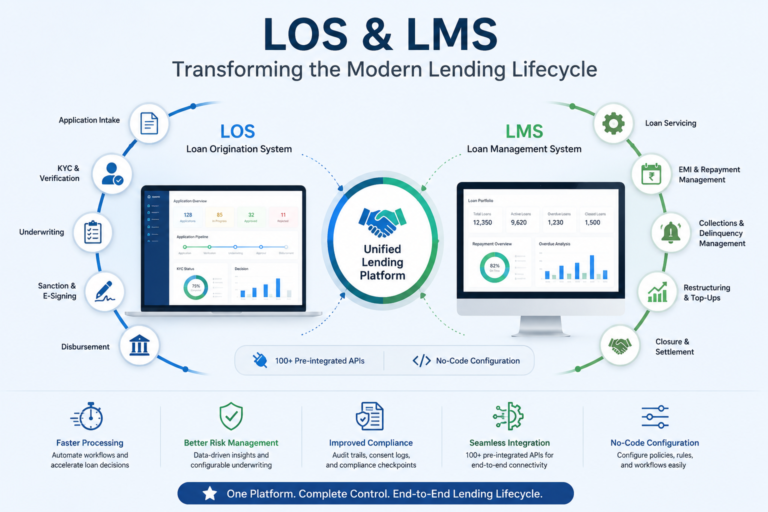
A Loan Origination System (LOS) manages the journey from loan application to approval and disbursement. FinAnalyz LOS digitizes key stages of the process, helping lenders reduce manual work and make faster, data driven decisions.
Key LOS Capabilities
- KYC & Verification: Integrate Aadhaar, PAN, GST, ITR, CKYC, EPFO, bank statement, and bureau checks.
- Digital Application Intake: Capture applications through branches, DSAs, and customer portals.
- Automated Financial Analysis: Analyze income, expenses, cash flow, and eligibility using smart data models.
- Automated Underwriting: Configure credit policies and decision rules with 350+ parameters.
- Digital Sanction & E-Signing: Generate sanction letters and support e-sign and e-stamp workflows.
- Faster Disbursement: Enable account validation, maker-checker approvals, and integrated fund disbursement.
Key impact: FinAnalyz states that its LOS can reduce loan turnaround time from days to minutes, support underwriting up to 60% faster, and provide a digital audit trail.
What Is a Loan Management System (LMS)?
Once a loan is disbursed, effective servicing becomes equally important. A Loan Management System (LMS) helps lenders manage repayments, EMIs, collections, restructuring, settlements, and loan closures.
FinAnalyz LMS brings these activities together through a unified dashboard, helping lenders improve operational visibility and customer service.
Key LMS Capabilities
- Customer Dashboard: Centralized access to loan and customer information.
- EMI & Repayment Management: Track repayments and automate reconciliation.
- Delinquency & Collections: Monitor overdue accounts and support proactive collection activities.
- Restructuring & Top-Ups: Modify loan terms, reschedule EMIs, or initiate top-up loans with traceability.
- Foreclosure & Settlement: Simplify loan closure with digital documentation and accounting workflows.
Why a Unified LOS + LMS Matters
Using separate systems for origination and loan servicing can create data gaps and operational complexity. A unified LOS + LMS platform connects the complete loan lifecycle, giving lenders greater visibility from application to repayment and closure.
The major advantages include:
Faster Processing: Automation reduces repetitive manual tasks and accelerates loan decisions.
Better Risk Management: Automated verification, financial analysis, and configurable underwriting rules support more consistent credit decisions.
Improved Compliance: Digital audit trails, consent logs, and compliance checkpoints help lenders maintain transparency and audit readiness.
Seamless Integration: FinAnalyz offers a plug-and-play API ecosystem with 100+ pre-integrated APIs covering areas such as KYC, GST, ITR, Bank Statement Analysis, Account Aggregator, and bureau services.
No-Code Configuration: Lenders can configure credit policies, underwriting rules, and workflows without extensive coding, helping accelerate implementation.
Built for Modern Lenders
FinAnalyz is designed with a focus on banks, NBFCs, fintech lenders, urban co-operatives, RRBs, and district co-operatives. Its transaction-based pricing model and configurable architecture can also make digital lending technology more accessible to smaller lenders.
The Future of Digital Lending
Modern lending requires more than simply digitizing paperwork. Lenders need connected systems that combine automation, analytics, compliance, integrations, and customer centric servicing.
With an integrated LOS and LMS, lenders can move toward a faster, more transparent, and scalable lending operation from the first application to the final repayment.
FinAnalyz Lending Suite brings the entire loan lifecycle together on one platform, helping lenders disburse faster, manage loans smarter, and build for sustainable growth.
FAQs
1. What is the difference between an LOS and an LMS?
A Loan Origination System (LOS) manages the lending process from application and verification through underwriting, approval, and disbursement. A Loan Management System (LMS) manages the loan after disbursement, including repayments, EMIs, collections, restructuring, settlements, and closure.
2. What are the benefits of using an integrated LOS and LMS platform?
An integrated LOS and LMS platform connects the complete loan lifecycle in one system. It can help lenders reduce manual work, improve operational visibility, accelerate loan processing, strengthen compliance, and provide a more consistent customer experience.
3. How does an LOS improve the loan origination process?
A Loan Origination System can automate application intake, KYC and verification, financial analysis, underwriting, sanctioning, e-signing, and disbursement workflows. This can reduce repetitive manual tasks and help lenders make faster, more consistent lending decisions.
4. What does a Loan Management System handle after loan disbursement?
A Loan Management System (LMS) helps lenders manage post-disbursement activities such as EMI and repayment tracking, reconciliation, delinquency monitoring, collections, restructuring, top-ups, foreclosure, settlements, and loan closure.
5. Who can benefit from an LOS and LMS platform?
An LOS and LMS platform can benefit banks, NBFCs, fintech lenders, urban co-operative banks, Regional Rural Banks (RRBs), and district co-operatives. It can help these organizations digitize lending operations and manage the loan lifecycle more efficiently.
Conclusion
A modern lending operation needs more than digital applications it needs a connected system that manages the entire loan lifecycle. An integrated LOS and LMS platform can help lenders streamline loan origination, automate underwriting, simplify disbursement, improve repayment management, and strengthen collections and compliance.
With FinAnalyz LOS & LMS, lenders can bring these processes together on a unified digital lending platform, supported by configurable workflows, integrated APIs, automation, and real-time visibility. This enables banks, NBFCs, fintechs, and cooperative lenders to process loans faster, manage them more efficiently, and deliver a smoother customer experience.
As lending continues to become more digital and data-driven, an integrated Loan Origination System (LOS) and Loan Management System (LMS) can provide the foundation lenders need to scale efficiently, manage risk, and build a more transparent and connected lending ecosystem.
